Table of Contents
TL;DR
Real-time decisions in fintech, adtech, and supply chain can’t run on batch data that’s hours or days old. Databricks Delta Lake fixes this by unifying batch and streaming on the same storage layer, so fraud checks, ad bids, and inventory decisions can run on fresh data instead of yesterday’s snapshot. Getting there takes more than flipping on streaming APIs, it requires validated data at the source, schema evolution that doesn’t break downstream jobs, and models that retrain continuously as patterns shift. Done right, this moves teams from reactive, next-day reporting to decisions that happen while the outcome can still be changed.
Executive Summary
Real‑time AI for fraud, ad bidding, and supply chain optimization is impossible on yesterday’s data. Databricks Delta Lake unifies batch and streaming on a single storage layer. It thus enables low‑latency ingestion, schema enforcement, and time‑travelled analytics from the same tables. With the right engineering patterns, enterprises can evolve from batch‑first reporting to streaming‑first decisioning where freshness directly impacts revenue and risk.
Introduction
Every business wants real‑time intelligence. In fintech, fraud needs to be stopped before authorization completes. In adtech, bids must be priced in milliseconds. In supply chains, routing decisions have to adjust before shelves go empty. Yet most enterprises still run their critical data flows on batch.
The default pattern is familiar – transactions, events, and logs land in databases or cloud storage. On a schedule (hourly, nightly, weekly) batch jobs extract new data, transform it, and load it into a central warehouse or lake. That architecture is perfectly adequate for financial reporting, compliance snapshots, and next‑day dashboards. It fails the moment value depends on reacting within seconds or minutes.
Databricks Delta Lake removes this constraint, serving as the foundation for real-time data pipelines that unify batch and streaming on a single storage layer – enabling low-latency ingestion, schema enforcement, and time-traveled analytics from the same tables.
The batch default
Most enterprises still operate a batch‑first architecture:
- Data lands in OLTP databases, APIs, event logs, or object storage.
- On a schedule (for example, every hour or every night), ETL/ELT pipelines read new records, process them, and load them into a warehouse or Delta Lake.
- Reports, models, and dashboards refresh based on this periodic snapshot.
Databricks’ own guidance describes batch processing as well‑suited for workloads with looser latency requirements where incremental refreshes are acceptable and stateful streaming complexity is unnecessary. That covers use cases like:
- Monthly and quarterly financial reports.
- Compliance and regulatory submissions.
- Marketing attribution and cohort analysis that can lag by a day.
But for real‑time scenarios, batch is a liability:
- Fraud analysis that sees a transaction hours later is just forensics.
- Programmatic ad auctions decided on stale user profiles lead to wasted spend.
- Inventory rebalancing after shelves are already empty only explains the failure. It does not prevent it.
When latency is directly tied to revenue protection or risk reduction, batch reschedules your decisions to too late.
Why Delta Lake changes the game
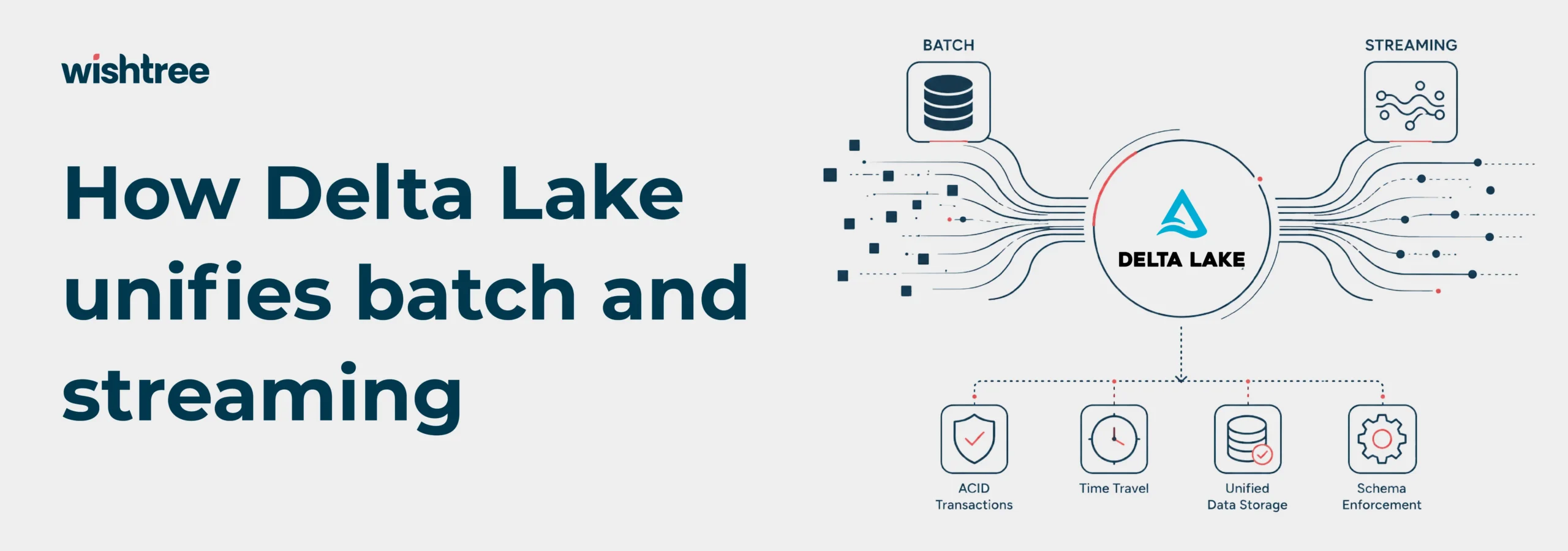
Delta Lake is a table format and storage layer that combines ACID guarantees, schema enforcement, and time travel with deep streaming integration. On Databricks, it is the backbone that allows batch and streaming to coexist on the same tables.
How real‑time streaming architecture on Databricks works
- Streaming ingestion into Delta tables
Spark Structured Streaming, Auto Loader, or other connectors ingest data directly into Delta tables using readStream and writeStream APIs. Delta Lake can act as both a streaming source and sink, maintaining exactly‑once processing even with multiple streams and concurrent batch jobs. - Schema enforcement and change handling
Delta tables enforce schemas, rejecting or quarantining data that does not match expectations. With features like change data feed, downstream consumers can process incremental inserts, updates, and deletes to maintain medallion architectures without full reloads. - Time travel and historical reconstruction
Delta Lake’s time travel lets you query tables as of specific versions or timestamps, capturing how the data looked at a given moment. That is critical when investigating incidents, back‑testing strategies, or training models on realistic historical slices. - Real‑time inference and decisions
Streaming tables and incremental processing allow models and AI agents to run on near real‑time data. Databricks examples show how streaming pipelines feed ML models and GenAI agents in fraud, personalization, and operations scenarios, combining Delta Lake with Mosaic AI for in‑platform decisions.
Because both batch and streaming workloads share the same Delta tables, you avoid dual infrastructures: one for real time and another for analytics.
This unified approach simplifies AI stack architecture by reducing the number of moving parts and ensuring that real‑time inference and historical analytics draw from the same governed data foundation.
Real‑world use cases
Fintech: real‑time fraud detection
A payment processor handles millions of card transactions per day. Fraud patterns evolve quickly across devices, geographies, and merchant categories.
- Batch-first: Transactions land in a warehouse after an hourly or nightly ETL. Models run after the fact, flagging fraud long after funds have settled.
- Delta streaming: Transaction events stream into Delta tables within seconds via Structured Streaming or CDC connectors. Mosaic AI–backed models and agents evaluate transactions in near real‑time against behavioral features and risk signals, triggering holds, additional verification, or alerts before authorization completes.
Result: fewer chargebacks and better customer experience compared to blunt, static rules.
Adtech: Real‑Time Bidding (RTB)
An ad exchange processes billions of bid requests daily, each requiring a decision in tens of milliseconds.
- Batch-first: User segments and campaign performance metrics are updated in bulk once or twice per day, leading to bids that ignore the latest behavior.
- Delta streaming: Clickstream events, impressions, and conversions feed streaming Delta tables; models trained on fresh features inform bidding logic and pacing in near real‑time. Models and agents running close to the data adjust bids, budgets, and creatives based on up‑to‑the‑minute engagement signals.
Result: higher win rates for valuable impressions and better yield for publishers.
2. Supply chain: real‑time inventory optimization
A retailer or logistics provider manages inventory and routes across thousands of locations and carriers.
- Batch-first: Order events, stock levels, and shipment updates are loaded into the lake nightly. Planners react to yesterday’s reality.
- Delta streaming:Orders, inventory changes, telematics, and supplier status updates stream into Delta tables as they occur. Predictive models and Mosaic AI agents adjust safety stock, reroute shipments, and escalate potential shortages before they hit customers.
Result: fewer stockouts, lower expedited shipping costs, and more resilient operations.
For organizations scaling this pattern, autonomous operations practices – predictive scaling, self‑healing pipelines, and automated incident response – ensure that streaming infrastructure remains reliable even as event volumes grow.
What it takes to get there
Transitioning from batch to streaming is not just turning on streaming APIs. It demands changes in how you think about data quality, evolution, and model lifecycle.
1. Data quality at the source
Streaming pipelines ingest whatever they receive – good or bad.
This is why data readiness for AI must come before streaming adoption – validating, cleansing, and structuring data at the source so streaming pipelines can deliver trustworthy inputs to real-time models.
- Bad encodings, out‑of‑range values, and malformed payloads arrive faster.
- Late and out‑of‑order events complicate stateful aggregations.
Databricks recommends pushing validation into ingestion and transformation using expectations, constraints, and tools like Delta Live Tables to define quality rules and quarantine bad data. That typically includes:
- Type and range checks at the edge of the pipeline.
- Quarantine zones in Delta for suspect events.
- Monitoring and alerts on quality metrics.
2. Schema evolution over time
Data contracts change:
- New fields are added to transactions, events, or logs.
- Existing fields change type or semantics.
Delta Lake supports schema evolution and keeps a transaction log of changes, making it possible to add columns without breaking historical queries or downstream jobs. Streaming architectures need:
- Agreed naming and versioning conventions.
- Observability around schema drift.
- Clear policies on deprecating fields.
3. Continuous model retraining
Patterns in fraud, advertising, and supply chains shift constantly:
- Fraudsters adapt to rules and detection models.
- User behavior and campaign dynamics evolve.
- Demand and supply conditions fluctuate.
Databricks workflows and ML tooling enable automated retraining and evaluation pipelines that use fresh Delta data to keep models up to date and safely promote new versions.
In a Mosaic AI context, this extends to multi‑agent systems that monitor model performance, update prompts or routing strategies, and provide human‑readable explanations.
This lifecycle approach is central to streaming-first product architecture, where models and agents are designed from the ground up to consume fresh data continuously rather than as a retrofit to batch-oriented systems.
Engineering Real‑Time Streaming on Databricks with Wishtree
For enterprises that need to move quickly, the difference between slideware and a production streaming system is often engineering depth and domain knowledge, not just platform features.
Wishtree is a product engineering partner focused on real‑time and AI‑native systems. For Databricks customers, Wishtree brings:
- Domain‑specific data models for fintech, adtech, and supply chain
Reusable schemas and modeling patterns for payment transactions, clickstream and bidding data, and supply chain events that map directly into Delta Lake and Unity Catalog. This accelerates medallion designs and governance setup. - Real‑time pipeline engineering into Delta Lake
Low‑latency streaming pipelines that ingest from payment processors, ad exchanges, OMS/WMS/ERP systems, or CDC‑enabled databases into Delta tables using Structured Streaming, Auto Loader, and streaming tables. - Production AI agents on Mosaic AI
With clean streaming data in place, Wishtree builds fraud detection models, bidding engines, and inventory optimization systems, plus Mosaic AI agents that work inside the lakehouse – querying Delta tables, triggering workflows, and acting on insights under native governance.
For deployments on AWS, Wishtree, a Databricks Partner, leverages cloud‑native patterns – networking, autoscaling, storage tiers – for streaming infrastructure optimization, ensuring Databricks clusters are sized appropriately for both throughput and cost efficiency.
To learn more, get in touch with us today!
FAQ
Is streaming always better than batch?
No. Databricks guidance is clear that streaming introduces complexity, especially with stateful processing and late events. Use streaming where freshness directly affects outcomes – fraud checks, RTB, operational routing – and keep batch for reporting, historical analytics, and slower‑moving metrics.
How does Delta Lake support streaming data ingestion?
Delta Lake integrates with Spark Structured Streaming, enabling tables to serve as both streaming sources and sinks via readStream/writeStream. It maintains exactly‑once semantics, efficiently discovers new files, and, with change data feed, propagates incremental changes to downstream tables.
What if our source systems do not have native streaming APIs?
Many legacy systems are batch‑oriented. Databricks and partners typically use change data capture (CDC), log shipping, or lightweight polling to convert database changes into streams that feed Delta tables. Wishtree builds connectors and CDC pipelines tailored to fintech, adtech, and supply chain platforms.
How do we handle data quality in streaming pipelines?
Implement validation at ingestion and transformation. Enforce schema and constraints in Delta, use Delta Live Tables expectations, and route invalid records to quarantine tables. This keeps critical downstream models safe while preserving faulty data for investigation.
Do we need a separate Databricks environment for streaming?
No. Streaming and batch workloads can share the same Delta tables and clusters, with streaming tables adding incremental processing semantics on top. Many teams start with one streaming use case alongside existing batch pipelines, then expand as patterns solidify.
How does time travel help in real‑time scenarios?
Time travel lets you reconstruct what the data looked like at any earlier point, which is vital for incident forensics, back‑testing fraud rules, and training models against realistic historical windows. You get real‑time access without losing reproducible history.
How do we decide when to go streaming‑first vs batch‑first?
Decision criteria include latency targets, arrival patterns, cost tolerance, data quality complexity, and governance requirements. Sub‑minute decisions with direct revenue or risk impact generally justify streaming‑first designs; hour‑plus tolerance usually favors batch or micro‑batch.
How does Mosaic AI fit into a streaming lakehouse?
Mosaic AI enables models and agents to run close to your data – reading Delta tables, calling functions, and triggering workflows within the lakehouse under Unity Catalog governance. Streaming pipelines ensure those models and agents work on fresh features instead of stale snapshots.
Can we phase in streaming without disrupting existing reporting?
Yes. Common patterns ingest new sources via streaming into bronze Delta tables, then materialize silver and gold layer views that both batch and streaming processes can consume. Reports continue to work while new low‑latency use cases come online incrementally.
How does Wishtree work with Databricks on real‑time projects?
Wishtree designs schemas, builds streaming pipelines, implements quality and governance, and deploys domain‑specific AI agents on Mosaic AI. Customers retain data and IP, and Wishtree’s role is to turn the Databricks platform into a streaming‑first backbone for fintech, adtech, and supply chain use cases.