TL;DR
Most enterprise AI starts as a quick API wrapper around a hosted model, but sending sensitive data to third-party servers and eating unpredictable per-token bills doesn’t hold up at production scale. The fix is hosting an open-source model privately with RAG, keeping data inside your own network while cutting costs at volume. Fine-tuning isn’t the first move here, RAG grounds the model in live enterprise data without retraining, and fine-tuning only comes in later for narrow cases like domain vocabulary or strict output formatting. Self-hosting wins once volume is high enough to keep the GPUs busy, below that, a hosted API is still cheaper.
Executive summary
Routing sensitive corporate data to public, third-party AI APIs introduces severe data privacy risks, vendor lock-in, and unpredictable per-token billing spikes. This technical guide by Wishtree Technologies outlines a practical framework for deploying self-hosted, open-source models (such as Llama 3 or Mistral) inside a private cloud environment paired with Retrieval-Augmented Generation (RAG). It provides engineering, security, and business leaders with a clear roadmap to transition from fragile API wrappers to cost-effective, enterprise-grade AI infrastructure.
Introduction
Most enterprise AI initiatives begin with an impressive demo. A developer hooks a hosted SaaS model API up to an internal document store over a weekend.
However, when moving from prototype to production, three structural bottlenecks emerge.
- Prompts and context chunks containing say PII, IP, or healthcare data leave your security boundary and traverse third-party servers.
- Infrastructure spend is bound to GPU instance hours rather than token consumption. High-volume document processing becomes significantly cheaper as throughput increases.
- Per-token billing works for pilots, but the problem is not the price per token – it is the volume. Agentic loops, tool calls, retries, and retrieval can multiply token consumption many times over per task, so bills grow fast and become hard to forecast even as headline token prices keep falling.
- Your execution speed is bound to third-party rate limits, shared tenant latency spikes, and external service outages.
Public models remain valuable for general experimentation. But for core enterprise workflows touching proprietary data, a private open-source LLM paired with a RAG architecture is the standard for long-term control and cost sanity.
Reference architecture: Private LLM + RAG stack
Modern open-source serving engines allow enterprise teams to host state-of-the-art open models inside their existing cloud VPC or on-premise infrastructure.
| Architectural layer | Recommended technology / tools | Primary responsibility |
| Model serving engine | vLLM, SGLang, TensorRT-LLM | High-throughput, low-latency inference; PagedAttention memory optimization. |
| Open-source base LLM | Llama, Mistral, Qwen, DeepSeek (7B–8B on a single commodity GPU; 70B+ for multi-GPU nodes) | Core reasoning engine running on private GPU compute (AWS EC2 / Azure NC-series). |
| Embedding engine | BGE-Large, E5-v2, Nomic-Embed | Converts unstructured enterprise text into dense vector representations locally. |
| Vector database | pgvector (PostgreSQL), Qdrant, Milvus | Sub-second semantic search, document chunk storage, and metadata filtering. |
| Orchestration & rules | FastAPI, LangGraph, Guardrails AI | Context assembly, token bucket management, PII redaction, and access control validation. |
The Fine-tuning misconception: Why RAG comes first
A common misconception is that enterprise data privacy requires fine-tuning a custom model from day one.
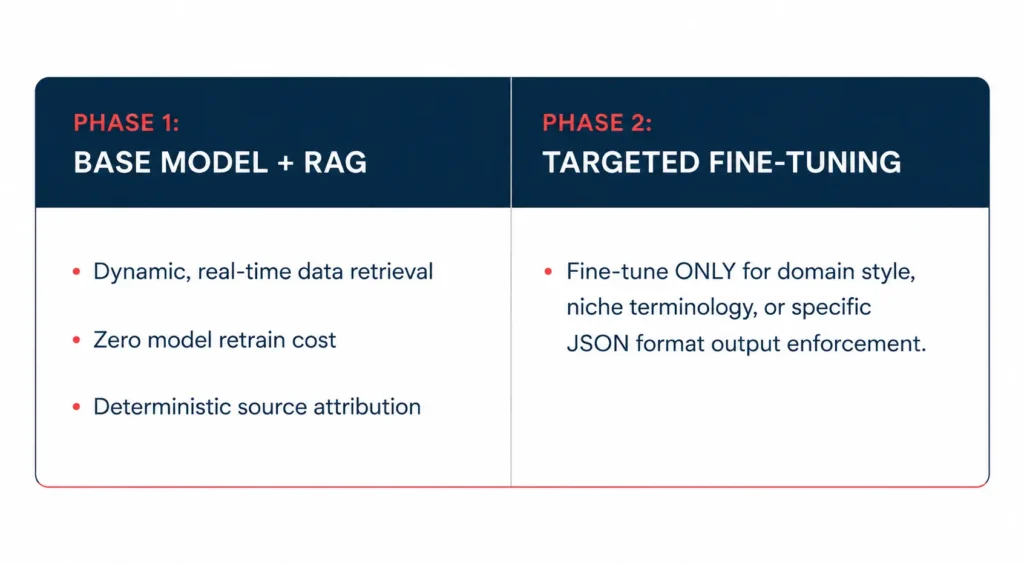
- Why RAG first: Grounding a base model with RAG ensures that your system reads live, dynamic enterprise data without expensive retraining cycles. It provides exact source attribution for audits and keeps knowledge completely separate from the model weights.
- When to fine-tune: Reserve LoRA / QLoRA fine-tuning for cases where a base model struggles with highly specialized syntax, internal domain vocabulary, or strict structured output constraints.
Cost & risk evaluation: Public API vs. Self-hosted infrastructure
Transitioning from third-party APIs to self-hosted infrastructure fundamentally changes your financial and risk profile.
Take a look.
| Monthly volume (70B-class quality) | Self-hosted | Hosted flagship API |
| ~1B tokens | ~$0.50 / M (illustrative) | ~$4–5 / M |
| 3–5B+ tokens | Cheaper, cost stays flat | Scales with every token |
- Cheaper at scale. Self-hosting is fixed GPU cost, not a per-token meter – so the more you run, the wider the savings.
- Mind the break-even. An idle GPU still costs full price. Self-hosting wins once volume keeps it busy (roughly a few billion tokens/month for 70B models). Below that, a hosted API is cheaper.
- Predictability is the real win. A fixed, forecastable bill instead of a usage-scaled one – the right fit for high-volume, sensitive workloads.
Privacy and control
– Prompts, context, and outputs never leave your network – simplifying HIPAA, GDPR, and SOC2 reviews.
– You control quantization (AWQ/GGUF), batching, and caching to hit your SLA and latency targets.
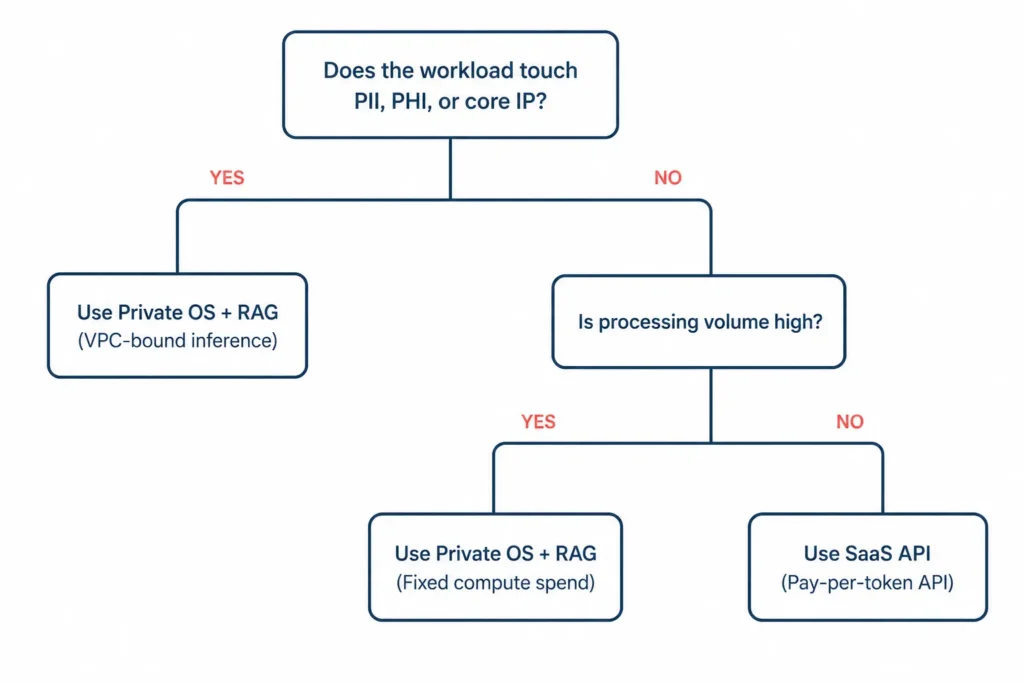
Decision framework: SaaS API vs. Private open-source
Use this rubric when evaluating pipeline patterns across different enterprise workloads:
Strategic guidance for enterprise leadership
- Treat model hosting as infrastructure. Model orchestration and serving belong inside your platform engineering roadmap.
- Calculate TCO Beyond API bills. Compare third-party token pricing against quantized open-source models running on auto-scaling GPU nodes over a 12-month horizon.
- Establish data boundaries early. Deploy private RAG infrastructure to unblock business units whose use cases are currently frozen due to security and compliance constraints.
How Wishtree Technologies powers private AI implementations
Wishtree Technologies helps enterprise organizations design, deploy, and scale private AI platforms across modern cloud environments. From hosting high-throughput open-source LLMs and configuring enterprise RAG layers to establishing automated guardrails, we ensure your AI systems remain secure, compliant, and cost-effective.
Ready to move your enterprise AI past fragile API wrappers? Contact us today to consult with our AI engineering architects.
FAQs
Do we need expensive GPU clusters to host open-source models internally?
Not necessarily. Modern quantization techniques (like 4-bit and 8-bit AWQ) allow high-performing models like Llama 3 (8B) to run efficiently on single commodity GPUs or small multi-worker nodes, making infrastructure costs very manageable.
Will an open-source model perform as well as top-tier proprietary SaaS models?
For domain-specific enterprise tasks backed by a well-architected RAG pipeline, fine-tuned or prompt-engineered open-source models regularly match or exceed proprietary models while operating at a fraction of the cost and zero data privacy risk.
How do we handle access control so employees only see data they are authorized to view?
Access control is enforced at the Vector DB and Orchestration layer. By applying metadata filtering tied to your enterprise IAM (e.g., Azure AD / Okta), the RAG pipeline only retrieves context chunks that the requesting user has explicit permissions to read.