
TL;DR
AI in CI/CD pipelines is transforming how Spring Boot microservices are built, tested, and deployed.
From predictive testing to AI-powered observability, pipelines are becoming autonomous.
Integrating machine learning in DevOps improves speed, reduces failures, and enhances deployment confidence.
If you’re still relying on traditional automation, you’re already behind.
Executive Summary
In the early days of microservices, we were happy just to have an automated pipeline. Today, in 2026, “automated” is no longer enough. As Spring Boot microservices CI/CD pipelines scale into hundreds of services, traditional approaches are hitting limits in speed, accuracy, and maintainability.
The new gold standard is AI-driven DevOps, where machine learning in DevOps and LLMs enable intelligent decision-making across the software delivery lifecycle. Organizations adopting AI-driven DevOps solutions are already seeing massive gains in efficiency and reliability.
By embedding AI in CI/CD pipelines, teams can:
Predict failures before they happen
Automate test selection and execution
Optimize Kubernetes deployments
Perform real-time root cause analysis
Enable intelligent CI/CD pipelines that self-heal
This shift is redefining CI/CD pipeline automation for Java applications, especially in complex Spring Boot deployment automation scenarios powered by modern cloud CI/CD services.
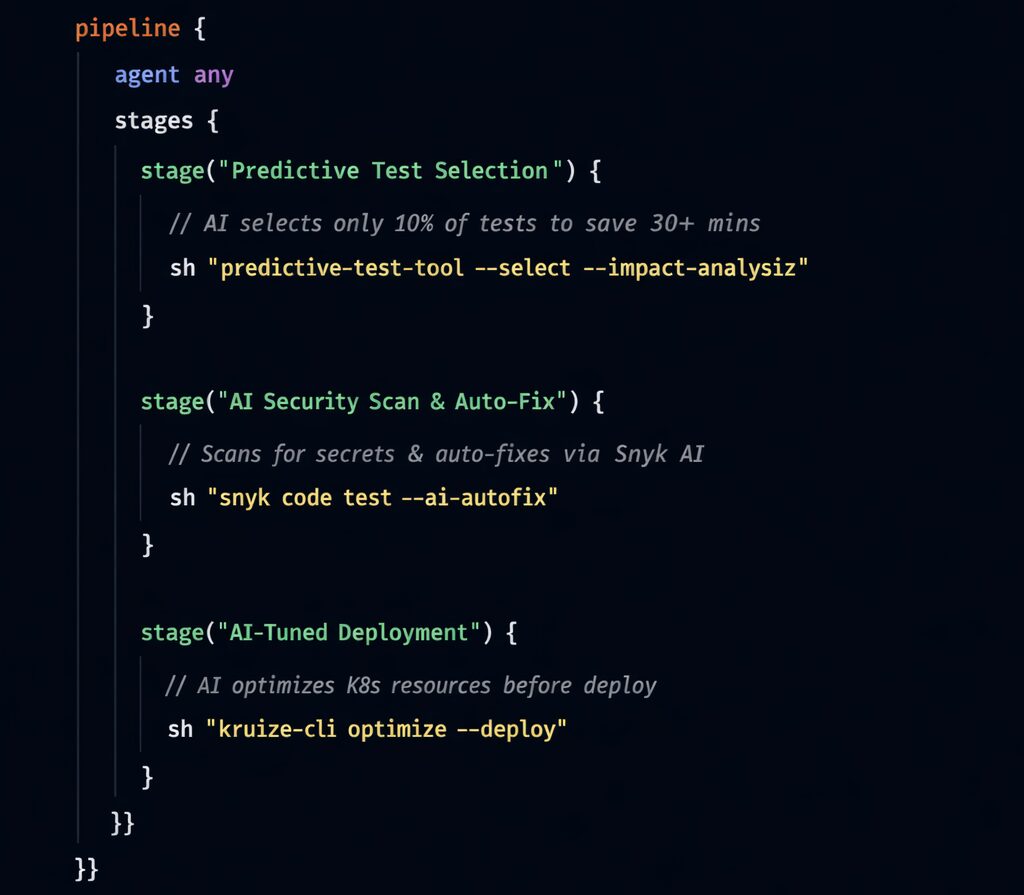
1. AI-Powered Predictive Test Selection in CI/CD Pipelines: No More 45-Minute Builds
The “Build All” approach is a productivity killer in modern CI/CD pipelines for Java applications, especially when working with enterprise-grade systems built by experienced Java developers. Even traditional “Smart Builds” (path-based) often fail in complex Spring Boot microservices architectures, where dependencies span across distributed systems.
The AI Shift:
Modern tools now bring AI-powered test automation in DevOps through predictive intelligence aligned with advanced software quality engineering practices.
How it works:
Instead of running every test, machine learning models in CI/CD pipelines analyze:
Code changes
Historical test outcomes
Dependency graphs
This enables intelligent CI/CD pipelines to execute only the most relevant tests based on risk.
Real-World Example:
Netflix applies AI in CI/CD pipelines at scale, reducing build times drastically while maintaining quality.
2. AI-Driven Architecture Guardrails in Microservices CI/CD
Poor architectural decisions can slow down even the most advanced enterprise software development initiatives. Sharing databases across services remains a critical flaw in Spring Boot microservices CI/CD pipelines.
The AI Shift:
Modern cloud engineering platforms now use AI to enforce architecture boundaries.
How it works:
AI agents perform static analysis across services and detect:
Cross-service schema access
Tight coupling issues
For deeper understanding of scalable systems, explore microservices architecture best practices.
3. AI in DevSecOps: Auto-Remediation for Secure CI/CD Pipelines
Security is a top concern in modern pipelines, especially when deploying applications in cloud-native environments supported by cloud security and governance frameworks.
The AI Shift:
With advancements in DevSecOps services, AI now enables automated vulnerability detection and remediation.
How it works:
AI tools:
Detect hardcoded secrets
Generate secure fixes
Improve secrets management in CI/CD pipelines
To understand real-world threats, refer to this guide on cloud security threats.
4. Eliminating Flaky Tests with AI-Based Anomaly Detection
Flaky tests are a common issue in CI/CD pipelines for microservices, often seen in distributed systems.
Explore how microservices impact testing strategies:
https://wishtreetech.com/blogs/digital-product-engineering/microservices-will-change-your-product-development-forever/
The AI Shift:
AI detects anomalies and improves reliability in automated CI/CD pipelines.
5. AI-Based Kubernetes Resource Optimization for Spring Boot
Modern applications require efficient resource utilization, especially during cloud migration journeys.
The AI Shift:
AI enables Kubernetes optimization and aligns with broader serverless and cloud scalability strategies.
For integration challenges, refer to:
https://wishtreetech.com/blogs/cloud-engineering/navigating-the-cloud-integration-maze/
6. Predictive Canary Analysis: AI-Based Deployment Strategies
AI-driven deployment strategies are essential for modern applications focused on performance and cost optimization via cloud cost and performance engineering.
Advanced resilience strategies are discussed here:
https://wishtreetech.com/blogs/cloud-engineering/the-future-of-cloud-resilience-how-ftr-and-ai-are-creating-self-healing-systems/
7. AI-Powered Observability and Root Cause Analysis in Microservices
Debugging modern applications requires deep visibility into distributed systems.
For broader context on complexity:
https://wishtreetech.com/blogs/digital-product-engineering/navigating-the-complexities-of-digital-product-development/
The AI Shift:
AI-powered insights leverage data analytics capabilities and data management systems to deliver actionable intelligence.
Conclusion
To stay competitive, organizations must adopt AI in CI/CD pipelines and evolve toward fully automated delivery systems supported by cloud CI/CD platforms.
Teams looking to scale faster can also consider hiring skilled experts, such as dedicated Java developers, to accelerate implementation.
Final Takeaways
AI in CI/CD pipelines is now a necessity
Machine learning in DevOps enables smarter automation
Spring Boot CI/CD pipelines benefit from predictive intelligence
AI-powered DevSecOps and observability reduce risk and downtime
Businesses investing in AI-driven DevOps gain a competitive edge
FAQs
What is AI in CI/CD pipelines?
AI in CI/CD pipelines uses machine learning and LLMs to automate testing, deployment, and monitoring processes, creating faster and more reliable software delivery systems.
How does AI improve Spring Boot CI/CD pipelines?
AI improves Spring Boot CI/CD pipelines by enabling predictive testing, automated deployments, anomaly detection, and enhanced security through DevSecOps practices.
What is predictive test selection in CI/CD?
It uses machine learning to analyze code changes and run only relevant tests, reducing build time while maintaining quality.
How does AI help in Kubernetes optimization?
AI optimizes resource allocation by analyzing performance and automatically adjusting CPU, memory, and scaling configurations.
What are the benefits of AI-driven DevOps?
AI-driven DevOps offers faster releases, improved reliability, better security, optimized costs, and reduced manual effort.