TL;DR
CEOs asking “which model should we use” are asking the wrong question. The right one is what outcome an AI initiative delivers and at what cost, unit economics, time-to-market, product velocity, not benchmark scores or architecture debates. The best implementations are “invisible AI”: customers and executives never think about which model is running underneath, because the org keeps a swap-ready integration layer that absorbs model changes without touching business logic. Practically, that means tying AI spend directly to operating leverage, demanding project leads show the cost/value shift per unit of work, and treating any initiative that can’t prove outcome velocity as an experiment, not a strategic investment, until it does.
Executive summary
For CEOs, the right AI question is what business outcome the AI will unlock. This blog by Wishtree Technologies reframes AI from a technical architecture debate to a business outcomes discussion – unit economics, time‑to‑market, and product velocity. It is written for CEOs, founders, and business leaders who need a clear way to evaluate AI initiatives without getting lost in model specs.
Introduction
Across the industry, AI conversations often start with technology:
- – Which model should we use?
- – Should we self‑host or use an API?
- – What about open‑source vs. proprietary?
For engineering teams, these are valid questions. For CEOs, they are secondary.
The primary question for business leaders is simpler:
What outcome does this AI initiative deliver, and at what cost?
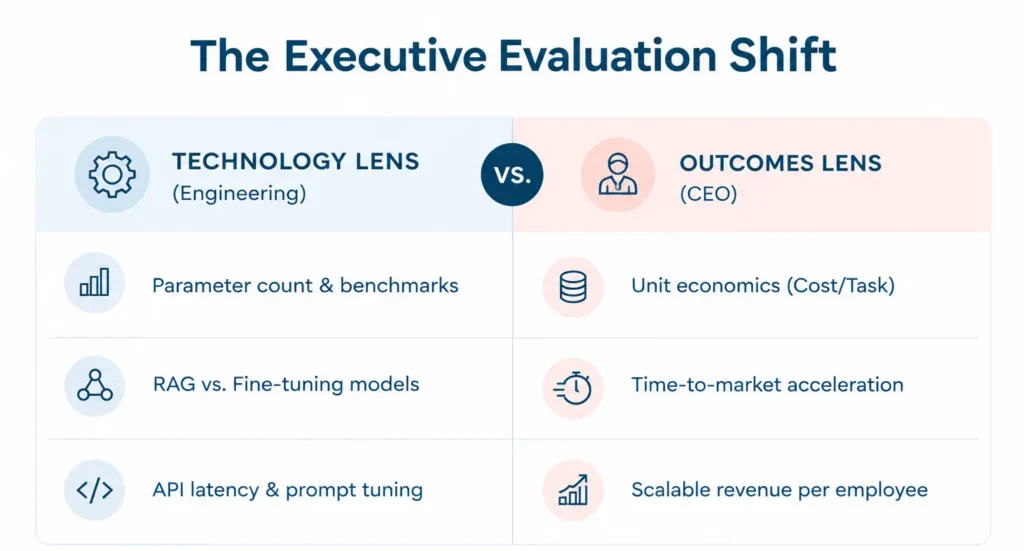
If an AI system does not improve unit economics, accelerate time‑to‑market, or increase product velocity, it is not a strategic asset. It is an experiment.
The Invisible AI approach
The most successful enterprise AI implementations are often those where end-users and executives never discuss the underlying model.
Customers do not care whether a resolution was generated by a proprietary frontier model or an open-weight one. The CEO does not track parameter counts or context window sizes. The conversation centers entirely on throughput, cost per transaction, and customer satisfaction. This is Invisible AI, where the model serves as an invisible engine behind real business value.
When AI becomes invisible within an organization:
- – Success is measured strictly in P&L metrics rather than benchmark scores.
- – Engineering teams focus on removing operational bottlenecks rather than tweaking prompts for a single vendor endpoint.
- – The organization maintains a swap-ready integration layer, so leadership can substitute models as pricing and capabilities evolve. The integration layer absorbs the re-tuning (prompts, evals, output parsing), keeping core business logic stable.
The velocity metric: What CEOs should track
A practical way to frame AI value for CEOs is through operational velocity: If switching from one approach to another accelerates engineering or operational output by X%, what is the true business impact?
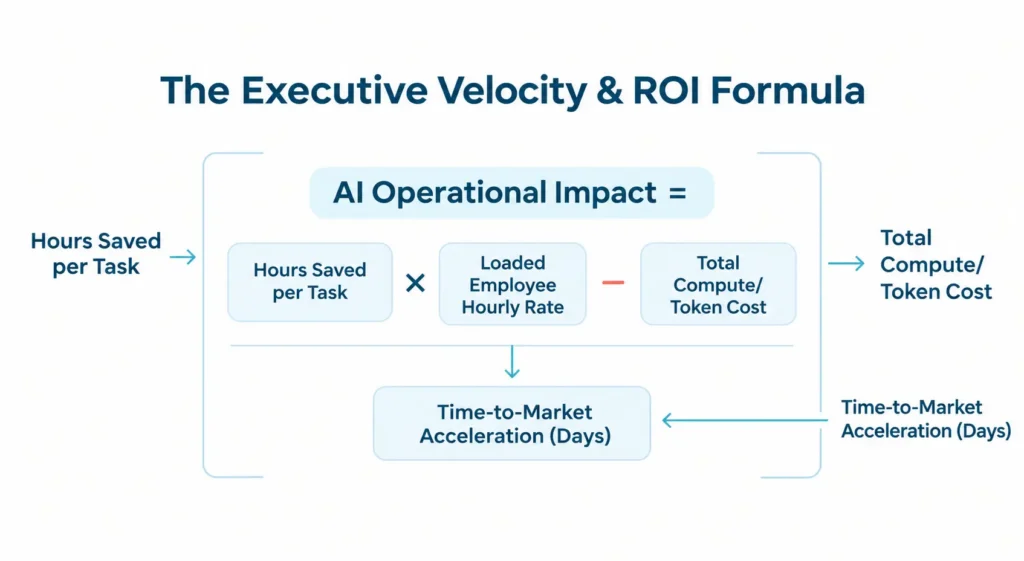
Multi-industry outcome matrix: AI as a P&L lever
Instead of viewing AI through a single narrow use case, high-performing CEOs evaluate how intelligent workflows alter unit economics across distinct corporate functions.
| Industry sector | Operational bottleneck | Invisible AI implementation | CEO-level business outcome |
| Enterprise Fintech & Banking | High cost per query during market volatility | Autonomous inquiry resolution & transaction routing | 60%+ reduction in cost per ticket, instant 24/7 SLA execution without linear headcount growth |
| B2B SaaS & Software Delivery | Slow feature release cycles and backlog friction | Anthropic Claude-assisted code generation & automated QA harnesses | 25–30% increase in sprint velocity, accelerating time-to-market for revenue features |
| Healthcare & Healthtech | Unstructured clinical notes consuming physician hours | Ambient clinical documentation & chart extraction via Claude’s extended context | 50% decrease in admin review time, increasing patient throughput and provider retention |
| Logistics & Supply Chain | Multi-vendor invoice auditing and dispute claims | Multimodal document parsing & automated reconciliation | 80% reduction in processing cycle times, directly curtailing operational leakage |
For most of these workflows the specific model is interchangeable. Where a frontier model is genuinely required, that is a deliberate capability decision. Either way, executive leadership tracks the outcome, not the model name.
Operational tradeoffs & pitfalls
High-performing leadership teams filter strategic AI discussions by actively prioritizing metrics over architecture details.
| What CEOs should ask | What CEOs should ignore |
| What metric moves? (Cost per transaction, time-to-market, CSAT) | Which model is “best” in benchmark tests? |
| What is the unit economics story? (Cost/value per unit of work) | Whether the stack uses RAG, fine-tuning, or agents. |
| What happens if we turn it off? (Would costs rise or quality drop?) | Technical details of prompts, embeddings, or vector databases. |
The implementation blueprint (executable checklist)
For CEOs and business leaders, transitioning from experimentation to strategic execution requires four directives.
- Tie all AI spend directly to operating leverage, cost reduction, or market expansion goals.
- Demand that project leads demonstrate how AI changes the cost and value of a single unit of work (e.g., ticket, claim, feature).
- Mandate open API proxies (e.g., LiteLLM, AWS Bedrock, or Anthropic Claude endpoints via enterprise gateways) so engineering can swap models under the hood without breaking business logic.
- If an AI initiative cannot demonstrate clear outcome velocity, limit its scope as an experiment and fund production deployment only when economic value is proven.
Conclusion
At Wishtree Technologies, we help enterprise leadership teams translate complex AI possibilities into tangible business performance. As partners across AWS, Databricks, and the Anthropic Claude Partner Network, we combine deep cloud architecture and model expertise to align AI initiatives with core operational metrics.
- Isolate true business leverage from high-cost technical experiments.
- Design integration layers that protect your business logic from vendor lock-in.
- Construct data and application foundations on AWS and Databricks that drive cost-per-task efficiency.
FAQs
Why should CEOs avoid focusing on model choice?
Because individual model advantages are temporary and increasingly commoditized. Long-term business outcomes – such as cost efficiency, execution speed, and service quality -are what create durable competitive moats.
What if engineering teams insist on discussing architecture?
Encourage them to do so. The engineering team’s role is to solve technical complexity; the CEO’s role is to ensure every architectural decision explicitly connects back to a business outcome and unit economics story.
How do we measure AI velocity gains?
Track operational baselines such as time-to-market, feature shipping cadence, tickets resolved per agent, or total cost per completed transaction before and after AI deployment.
Is an outcome-focused AI strategy only relevant for large enterprises?
No. Mid-market companies and startups gain an even higher relative advantage by avoiding costly technical experiments and focusing compute resources strictly on high-impact business bottlenecks.
What if an AI initiative cannot show clear outcomes?
Reclassify it as an isolated experiment rather than a strategic investment. Limit resource allocation, set explicit outcome benchmarks, and fund full production deployment only when metrics prove out.
How does Wishtree’s partnership with Anthropic benefit our enterprise AI strategy?
Through our participation in Anthropic’s Claude Partner Network alongside AWS and Databricks, Wishtree combines leading reasoning models like Claude with enterprise-grade data governance, ensuring your AI deployments are secure, cost-effective, and tied directly to operational ROI.