Table of Contents
TL;DR
A Claude workflow can look great in a pilot and still fail its first serious compliance review, because governance bolted on at the end always finds gaps: unapproved data sources, unclear ownership, no audit trail. The fix is treating governance as architecture, not a final approval gate: define what Claude can access, what it can produce, what evidence gets recorded, and who’s accountable, before the workflow goes live. Not every use case needs the same level of control, a simple internal summarizer needs less scrutiny than a workflow touching lending or clinical decisions. The real deliverable isn’t a policy document, it’s a reusable set of controls, data access patterns, and audit logging that the next Claude deployment can build on instead of starting from scratch.
Executive summary
A Claude-powered workflow can perform well in a pilot and still fail its first serious governance review. This blog presents a practical governance model for Claude-powered workflows in BFSI, healthcare, and other sectors where AI-assisted activity must be explainable, reviewable, and accountable.
Introduction
Generative AI has officially moved to a frontline operational priority. In banking, healthcare, and insurance, models like Claude are already being put to work across claims, underwriting, documentation, and compliance.
But can the workflow survive contact with sensitive data and live operations?
A slick demo is not an operational green light. Moving from a controlled pilot to live systems raises non-negotiable questions: Which databases can the model query? Who validates its output? How is the interaction logged for regulatory audit? Where does accountability rest when something fails?
Governance is an architecture problem. Treating compliance as a late-stage review is what kills promising initiatives. Production-ready AI requires hard engineering controls built directly into every layer of the stack – from data pipelines and user permissions to human oversight loops and continuous audit logging.
Testing a tool is not the same as operating it. Anthropic makes this exact distinction in its own partner program – registering a use case or running a pilot does not count as a win. Value is measured strictly by sustained, live production deployment.
The demo passed. The review did not.
Say, a claims team is using Claude to summarise customer correspondence and policy documents. The output is clear, the review time falls, and the operations team wants to move ahead.
Then the governance questions begin:
- – What information did Claude access?
- – Was sensitive data included?
- – Who reviewed the output?
- – Can the organization reconstruct the interaction later?
- – What happens when the summary misses a critical detail?
- – Who owns the workflow after launch?
The pilot team may have informal answers. A production system needs documented and enforceable ones.
This is where projects often slow down. The business sees value, while security, compliance, legal, data, and engineering teams see an incomplete control environment.
Both perspectives are valid. A Claude workflow must be useful enough for people to adopt and controlled enough for the organization to defend.
Governance is an operating model
Governance often appears as a final approval gate. A project team builds the workflow, and risk or compliance is asked to review it shortly before launch.
By that point, the workflow may already depend on unapproved data sources, broad user permissions, or automation that no team is prepared to own.
A more effective model assigns responsibility early:
- – The business defines the intended outcome and acceptable risk.
- – Engineering designs the application and integration pattern.
- – Data teams define the information Claude can access.
- – Security controls identity, permissions, and monitoring.
- – Legal and compliance establish accountability and evidence requirements.
- – Operations owns the workflow after launch.
This does not require a large committee for every use case. It requires the right decisions to be made before the workflow becomes difficult to change.
Four boundaries to define
A practical governance model begins with four boundaries.
| Boundary | The question it answers | Example |
| Data | What can Claude access? | Approved policy documents and selected claim records |
| Decision | What can Claude produce or recommend? | A summary or follow-up suggestion, not a final claim decision |
| Evidence | What must be recorded? | Sources, output, reviewer action, and workflow version |
| Ownership | Who is accountable? | Named business, engineering, security, and compliance owners |
These boundaries turn broad concerns about “safe AI” into design decisions that can be tested.
They also expose a common misconception. A well-written prompt is not a complete control. Prompts can guide behaviour, but they cannot replace access policies, data filtering, approval mechanisms, audit logging, or incident response.
A claims workflow in practice
Consider a claims organization that wants to reduce the time adjusters spend reviewing documents.
The workflow connects Claude to approved policy documents, claim correspondence, and selected case information. Claude prepares a structured summary and identifies missing information. An adjuster reviews the output before deciding what action to take.
Claude may assist with:
- – Summarising long documents
- – Identifying relevant clauses in approved policy material
- – Highlighting missing information
- – Preparing follow-up questions
- – Drafting internal notes for review
The workflow should not allow Claude to:
- – Make the final coverage decision
- – Change a claim without an authorised user action
- – Retrieve every customer record by default
- – Treat an unverified output as an approved business decision
The audit trail should connect the AI interaction to the business process. Depending on the organization’s requirements, that may include:
- – The user who initiated the request
- – The data and documents made available
- – The workflow and prompt version
- – Claude’s output
- – The adjuster’s edits or approval
- – The final action recorded in the claims system
We need to define what evidence is necessary, apply appropriate retention rules, and make that evidence available when a case requires investigation.
Controls belong in the architecture
A policy may state that Claude can access only approved data. The architecture must enforce that rule.
Relevant controls may include:
- – Identity-based access linked to the user’s role
- – Dedicated data views for AI-enabled workflows
- – Masking or removal of sensitive fields before retrieval
- – Retrieval limited to approved repositories
- – Application controls that prevent unauthorised actions
- – Logs connected to the relevant claim, case, ticket, or record
- – Version control for prompts, tools, policies, and workflow logic
- – Monitoring for quality problems, unusual usage, and repeated failures
These are not separate from AI delivery. They are part of the delivery.
The same principle applies when the workflow changes. A new data source, additional user group, broader permission, or automated downstream action can materially change the risk profile. The architecture should make those changes visible and reviewable.
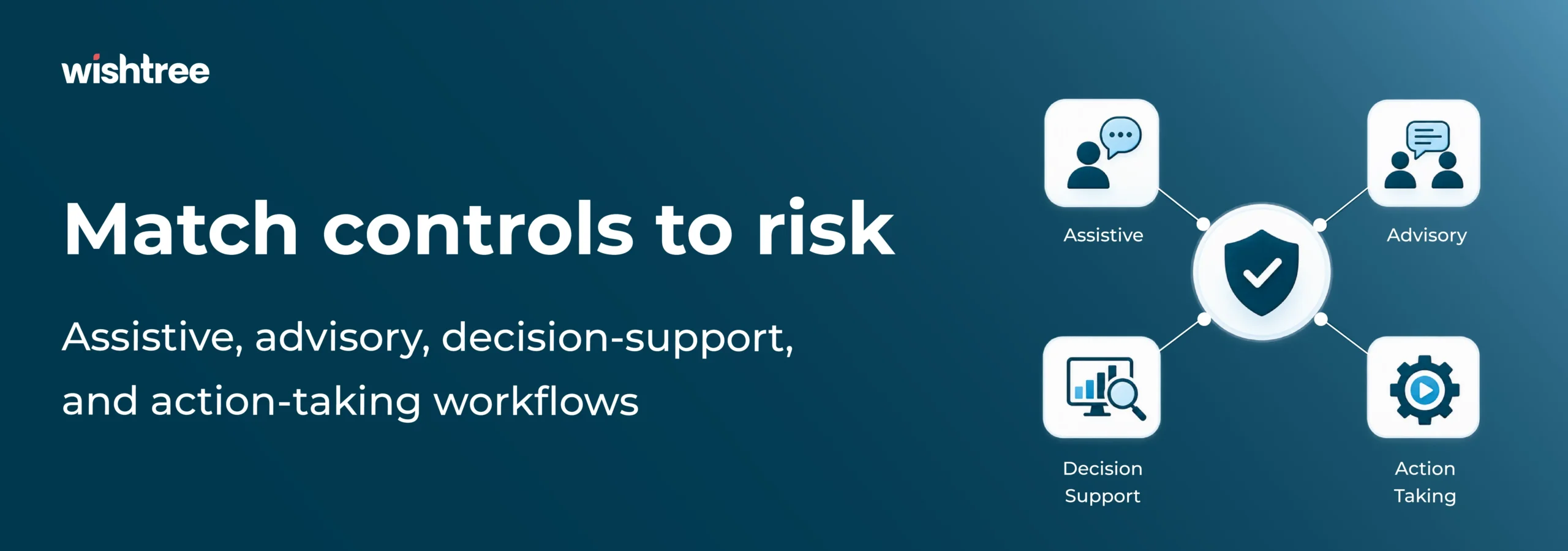
Match controls to risk
Not every Claude use case requires the same level of control. Applying one approval process to every workflow creates unnecessary delays, while treating high-impact use cases like simple productivity tools creates avoidable risk.
| Workflow type | Typical use | Control posture |
| Assistive | Internal search, summarisation, first drafts | User review, source visibility, access controls |
| Advisory | Recommendations, case prioritisation, compliance drafting | Human approval, stronger testing, detailed logging |
| Decision-support | Lending, claims, clinical, or surveillance workflows | Defined accountability, documented rationale, enhanced monitoring |
| Action-taking | Updating records or triggering downstream actions | Explicit authorisation, transaction controls, rollback, full audit trail |
The model should not receive more authority simply because an earlier version performed well. Every increase in data access or system capability should trigger an appropriate review.
What must be established before go-live
Before approving a Claude-powered workflow, the review should establish:
- – What business process is changing
- – What Claude can and cannot do
- – Which data sources are connected
- – Which users can access the workflow
- – What a human must verify or approve
- – How quality and failures will be monitored
- – How users can report unsafe or incorrect output
- – How changes will be tested before release
- – What evidence will be retained
- – Who can pause, modify, or retire the workflow
Success should also be measured beyond response quality or usage volume. Useful measures may include reduced handling time, lower rework, improved completeness, fewer avoidable errors, or better employee experience – provided those gains do not weaken the organization’s control environment.
Anthropic’s public customer story criteria connect a production Claude deployment to a defined business problem, the solution delivered, and a measurable outcome. Enterprises can apply the same discipline internally by requiring every workflow to have a clear purpose, an accountable owner, and evidence of value.
Build once, reuse responsibly
The first production workflow will require more effort because the organization is establishing its patterns for data access, logging, approvals, evaluation, and incident handling.
That investment becomes valuable when it is reused.
The next Claude workflow should be able to build on:
- – Approved integration patterns
- – AI-specific data access controls
- – Shared logging and monitoring components
- – Standard evaluation methods
- – Risk classification criteria
- – Human approval patterns
- – Change management procedures
This is how an organization moves from isolated AI features to an enterprise capability. Governance becomes less about reviewing each project from scratch and more about applying proven controls to a new business context.
Make governance part of delivery
The strongest governance model is the one that lets an organization answer difficult questions clearly while keeping useful workflows moving.
For enterprises adopting Claude in 2026, that means connecting business purpose, data access, human accountability, technical controls, and measurable outcomes from the start.
Wishtree Technologies helps enterprises design and implement AI workflows across their existing cloud, data, and application environments. We, as part of the Claude Partner Network, engineer the controls that make the workflow practical to operate and ready to scale.
If your Claude initiative is technically promising but has stalled in security, compliance, or risk review, start with one workflow. Define its boundaries, assign ownership, build the evidence trail, and create patterns that the next deployment can reuse.
Contact us today to get started.
Frequently Asked Questions (FAQs)
Does governance prevent enterprises from moving quickly?
It can when governance is introduced only at the end. When controls are designed alongside the workflow, they reduce late-stage rework and make future deployments easier to assess.
Should Claude make decisions in regulated workflows?
In many regulated workflows, Claude is better used for summarisation, retrieval, classification, drafting, or recommendations. An authorised human should remain responsible for the final decision wherever the consequences require human accountability.
Are prompts enough to protect sensitive data?
No. Prompts do not replace identity controls, data filtering, masking, environment separation, application permissions, or audit logging.
What should be logged?
Organizations should be able to connect the user, data context, workflow version, Claude output, human review, and downstream action. The exact scope should reflect the workflow, privacy obligations, and retention requirements.
Can a pilot use production data?
Not by default. A pilot should have a defined environment, approved data scope, and clear rules for handling sensitive information. Anthropic’s programme guide also distinguishes sandbox activity from production deployment and states that sandbox credits are intended for building and testing, not production use or regulated-data testing.