
TL;DR
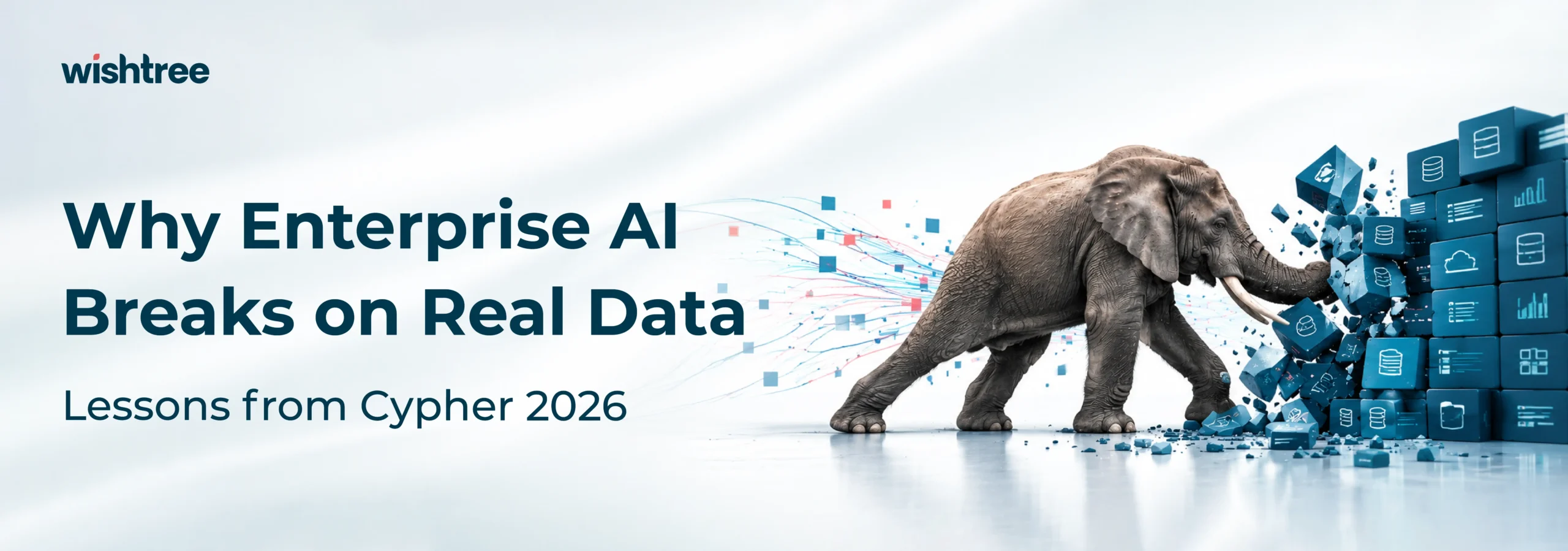
Your AI demo looked great on a few clean PDFs, then fell apart the moment it touched real systems. At Cypher 2026, we heard the same story again and again: the problem usually isn’t the model, it’s the enterprise data stack behind it. Data sits in separate pockets, security rules are scattered across half a dozen tools, and custom scripts can’t hold it all together. A unified lakehouse with Databricks Unity Catalog fixes that by letting your AI app inherit each user’s permissions, so it only sees what that person is allowed to see.
Getting to data readiness for AI comes down to a few practical moves:
- – Keep your data in open, reliable formats so multiple tools can use it without creating duplicate security risks.
- – Enforce access control at the data layer, not inside prompts or front-end code.
- – Bring engineers in early, since solid data pipelines matter far more than prompt tweaks.
- – Go beyond basic document search (RAG) so your AI can combine text with live, structured data like inventory or transactions.
Introduction
Tried building an internal AI tool or smart assistant over the last year?
Tell us if this sounds familiar.
Day one, the demo looked amazing. You fed the model a few clean PDFs, typed some prompts, and it answered right away.
Then you connected it to your real systems – inventory, customer records, internal wikis, and it fell apart.
At Cypher 2026 in Bengaluru, an engineering lead told the Wishtree team this exact scenario was their biggest headache. Their enterprise data stack was never built to feed an AI engine.
Why enterprise AI breaks without business context?
When a human employee answers a complex business question, do they need to search for keywords?
No. They naturally understand context, access permissions, and business rules built up over years.
An AI model does not have any of that context out of the box. You need accurate, safe responses, but your AI model relies entirely on the quality of the data architecture feeding it.


In most companies, data lives in separate, isolated pockets.
- – Sales records live in a cloud data warehouse.
- – Operational notes sit inside unstructured files on cloud storage.
- – Security permissions are managed across half a dozen different identity tools.
Trying to duct-tape these disconnected sources together using custom scripts is why so many AI pilots break the moment they leave the sandbox.
Why unified data governance changes the game?
To fix this, leading engineering teams are abandoning the idea of copying data into separate AI tools. Instead, they are moving toward a unified data lakehouse model that sits directly over all company data. A data lakehouse combines the low-cost storage of a data lake with the performance and structure of a data warehouse, so one copy of your data can serve both analytics and AI.
This is where being a Databricks consulting partner gives us, and our clients, a real operational edge.
When you build on a unified foundation like Databricks, you solve three major technical hurdles at once:
1. One security rulebook for everything
Instead of rewriting security rules for every new AI app, Databricks Unity Catalog enforces permissions at the root data level.
When your AI app queries data on behalf of a signed-in user, it inherits that user’s permissions – row filters and column masks included.
So if a customer service agent cannot see executive salaries, neither can their AI assistant.
2. Live data without constant data motion
AI tools need access to fresh, real-time information. A lakehouse architecture allows AI models to run queries directly against streaming data and operational logs without forcing developers to export and move massive files back and forth every night.
3. Predictable compute & storage costs
When data is duplicated across multiple niche AI tools, cloud storage and compute charges multiply rapidly. A unified platform optimizes query performance and automatically scales compute resources down when idle. That way, it keeps your monthly infrastructure spend predictable!
Want to go deeper on spend? See our guide to cloud cost optimization. Still deciding between platforms? Our Databricks vs Snowflake comparison covers where each one fits.

Move beyond basic RAG and simple document search
Many of the early enterprise AI attempts were basic “document search” tools (often called standard RAG). They pulled matching text from documents and passed it to the model, with no access to live structured data like inventory or transactions.
Real-world business problems require much more than that. Modern AI applications need to combine unstructured text (like support tickets or email threads) with structured numbers (like live inventory counts or transaction logs).
When you organize your data layer properly, your AI tools can handle multi-step operational tasks.
| Retail & e-Commerce | Healthcare & life sciences | Financial services |
| Checking live warehouse stock while simultaneously drafting an accurate response to a customer dispute. | Summarizing patient histories while strictly honoring patient privacy guidelines across regions. | Analyzing transaction patterns across millions of records without exporting raw customer data to third-party servers. |
How to get your data ready for production AI?
If you want to stop patching broken AI scripts and start building tools that actually scale, data readiness for AI comes down to three practical steps:
- Keep your data in open, reliable formats, so multiple tools can access it without creating duplicate security risks.
- Enforce access control at the data layer, not inside individual software prompts or front-end code.
- Bring engineers in, early. AI success relies far more on solid data pipelines than on prompt tweaks.

Want to test your enterprise data stack before scaling?
At Wishtree, we work with mid-sized and enterprise teams on data pipeline optimization services, automated governance, and production-ready AI development services built on robust cloud and Databricks architectures.
Want to see how your current data stack holds up under real AI workloads? Start a risk-free trial with our engineering team today.
Frequently Asked Questions (FAQs)
Why does our enterprise AI chatbot work in testing but fail in production?
Test environments usually run on small, clean datasets. Real production systems deal with messy, changing data and strict access permissions. When those underlying permissions are not unified, the AI either gives inaccurate responses or fails to pull the necessary context.
How does Databricks Unity Catalog help with enterprise AI security?
Databricks uses Unity Catalog to manage governance across all your data assets – be they structured tables or unstructured files. This means your security rules, user permissions, and audit trails are managed in one central place.
That gives your AI applications the same governed, auditable access as the rest of your data, which is a strong base for meeting compliance requirements.
Do we need to migrate all our data to Databricks to use it for AI?
No. Databricks runs on open formats. It connects straight to your cloud storage – AWS, Azure, Google Cloud. Because the formats are open, your data stays portable.
And with Lakehouse Federation, it can query PostgreSQL, SQL Server, or Snowflake in place. Nothing gets copied.
How quickly can Wishtree help us with data readiness for AI?
We can jump in immediately. Whether you need a full architecture assessment or dedicated data engineers to accelerate your development timeline, reach out to our team today to get started.