TL;DR
Leading with “we use the best model” is a fragile positioning strategy, competitors can license the same model within weeks. As foundation models follow the same commoditization path as cloud compute, durable value moves to three places: proprietary data and context competitors can’t replicate, deep native workflow integration that raises switching costs, and trust systems (evals, PII masking, audit trails) that matter in regulated industries. The practical shift for GTM leaders: stop naming the model in headline positioning, lead with measured business outcomes instead, and treat compliance and governance as a sellable feature, not a technical footnote.
Executive summary
For B2B marketing, product, and Go-To-Market (GTM) leaders, foundation models are becoming a utility. This blog reframes AI strategy from model-centric positioning to an outcome-driven GTM strategy. It maps where enterprise value accrues – specifically across Proprietary Context, Native Workflow Deep-Binding, and Systemic Trust, providing CMOs and GTM executives with an actionable framework for building defensible market positioning.
Introduction
In executive strategy sessions and GTM positioning workshops, the product narrative often begins with the same technical questions:
- – “Which frontier foundation model are we running under the hood?”
- – “Are we using the latest model release?”
- – “How does our technical benchmark score compare to our nearest competitor?”
For engineering teams, these are architectural questions. But for marketing and GTM leaders, leading with model specs is a positioning trap.
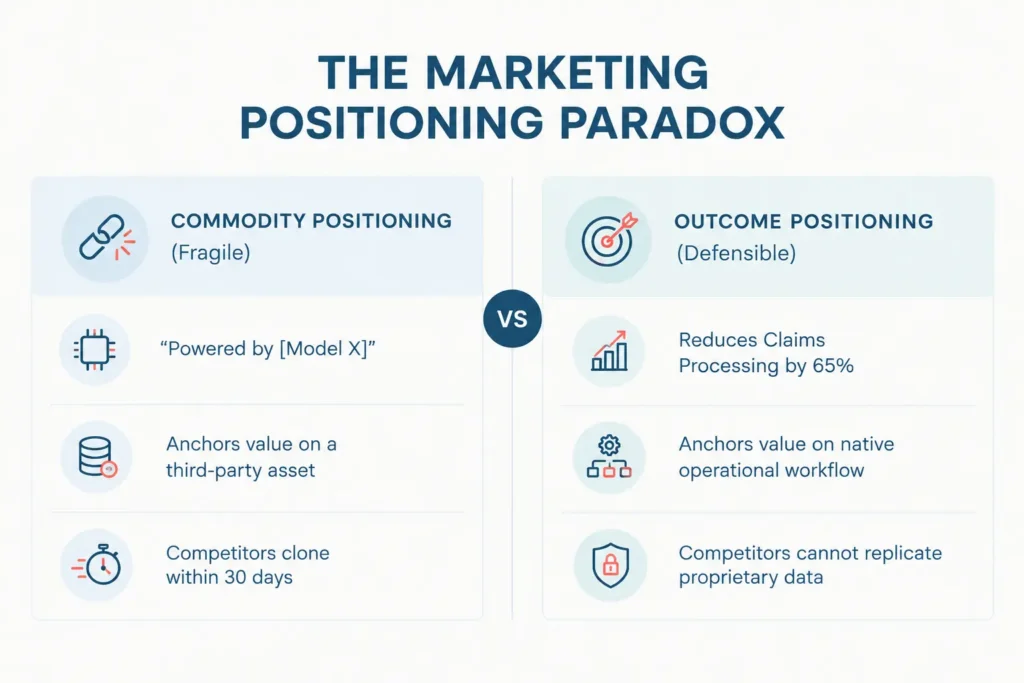
When your primary value proposition is “we use the best model,” you anchor your market differentiation on a third-party commodity that your competitors can license overnight. Foundation models are quickly following the trajectory of cloud compute and electricity – essential table stakes, but completely invisible to the buyer’s evaluation of core business value.
The commoditization trajectory
The evolution of artificial intelligence mirrors previous historical technology infrastructure shifts.
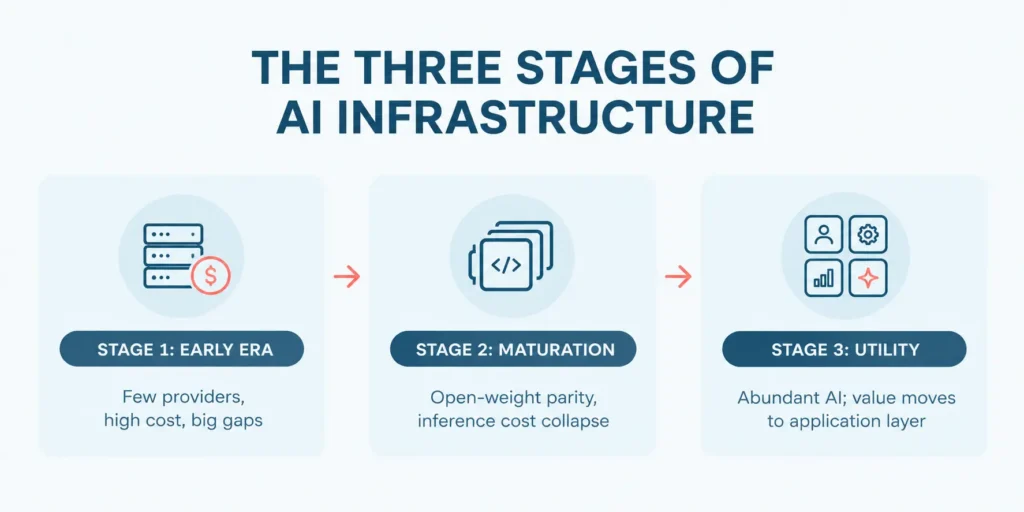
- Early phase: A handful of proprietary model providers charge premium prices. Early adopters gain a temporary marketing advantage simply by offering LLM capabilities.
- Maturation phase: Open-weight models achieve benchmark parity on core reasoning tasks. Rapid hardware optimization drives inference costs down exponentially.
- Utility phase: Intelligence becomes abundant and cheap. Market value shifts entirely from the underlying model to how seamless the application layer executes the work.
We have entered the Utility Phase. Whether running frontier models like Anthropic Claude or optimized open-weight alternatives, raw capability is now table stakes.
Where value accrues: the three GTM moats
When raw intelligence is cheap, durable enterprise value accrues across three specific application layers.
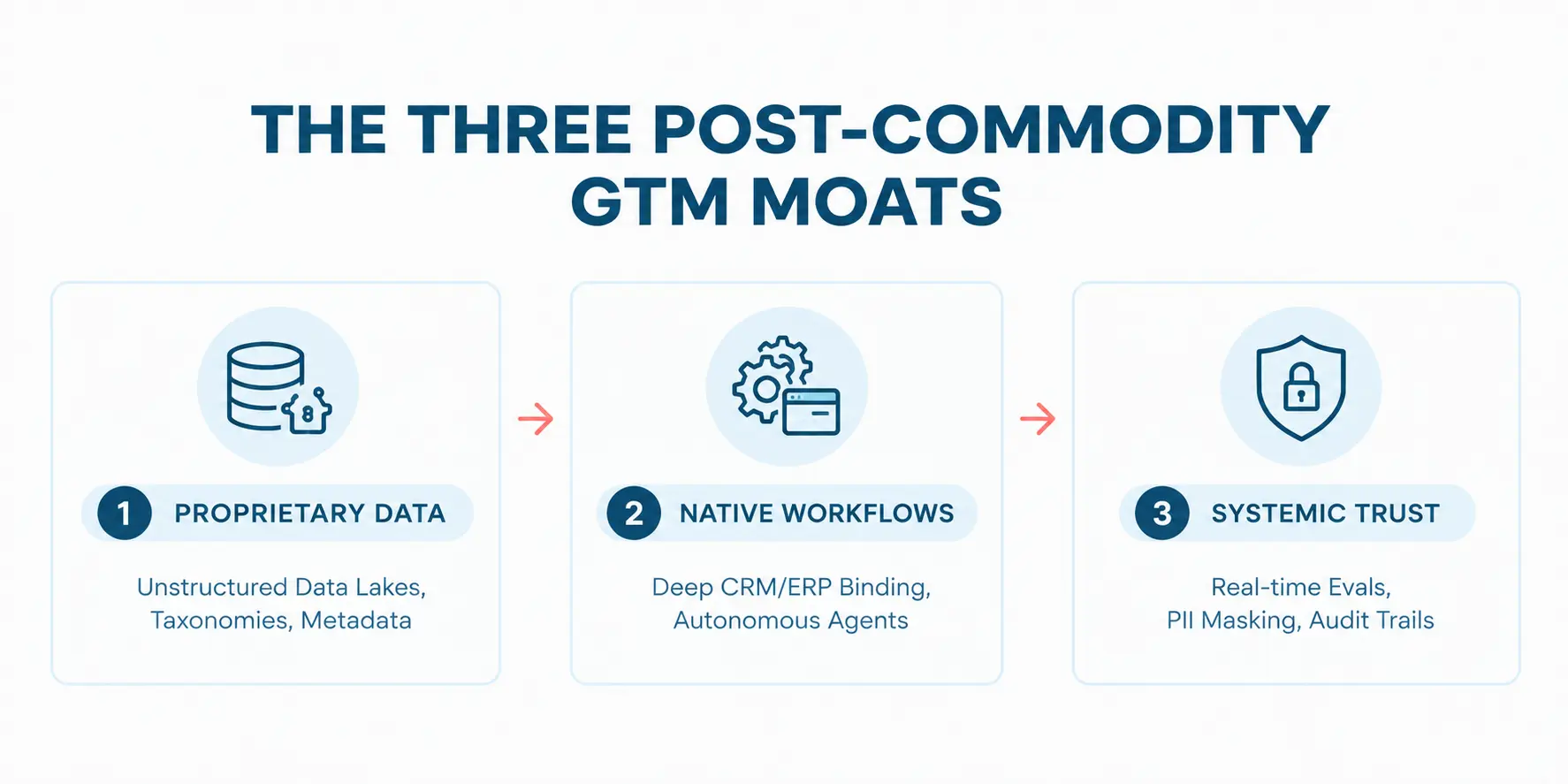
| Value layer | GTM focus area | Why buyers pay a premium |
| 1. Proprietary context & data | Enterprise knowledge bases, taxonomies, domain schemas | Generative AI cannot replicate internal operational logs, domain ontologies, or private historical context. |
| 2. Workflow deep-binding | Native ERP/CRM integration, agentic task execution | Buyers purchase time savings and workflow automation. High switching costs retain users. |
| 3. Trust & reliability systems | Continuous evals, PII filtering, human-in-the-loop (HITL) | In mission-critical enterprise environments, verified accuracy and regulatory compliance are non-negotiable. |
Implications for positioning and messaging
To escape the commoditization trap, CMOs and GTM leaders must execute three tactical pivots in their positioning strategy:
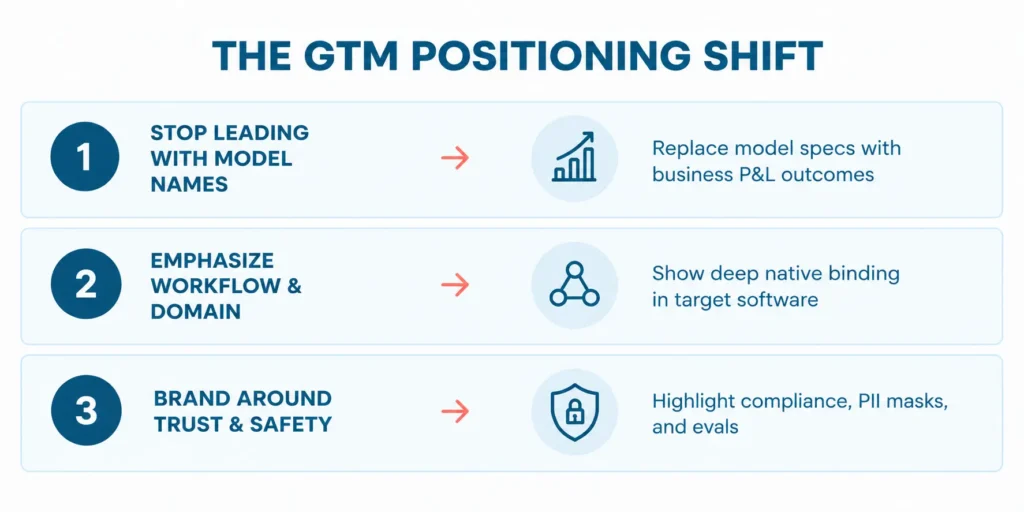
1. Stop leading with model names
Promoting “Powered by [Model X]” leaves your story vulnerable to third-party vendor changes and competitor cloning.
Frame positioning around concrete business outcomes – operational cost reduction, revenue enablement, and product development speed. Use underlying partner tech (like Anthropic Claude or AWS Bedrock) as supporting technical evidence in deep-dive collateral.
2. Highlight domain knowledge and Workflow deep-binding
Enterprise buyers pay for software that solves specific operational pain points within their daily software stack (e.g., healthcare clinical notes, financial underwriting, complex customer support).
Position your product around native process automation and domain-specific taxonomies. Highlight how seamlessly your platform integrates into existing enterprise ERP, CRM, or data lake environments.
3. Make enterprise trust a headline feature
In regulated industries (finance, healthcare, legal), reliability and risk mitigation are top buying criteria.
Promote governance tools as core product capabilities – real-time hallucination guardrails, PII masking, SOC2 compliance, and audit trails. Position your solution as safe to scale across mission-critical workloads.
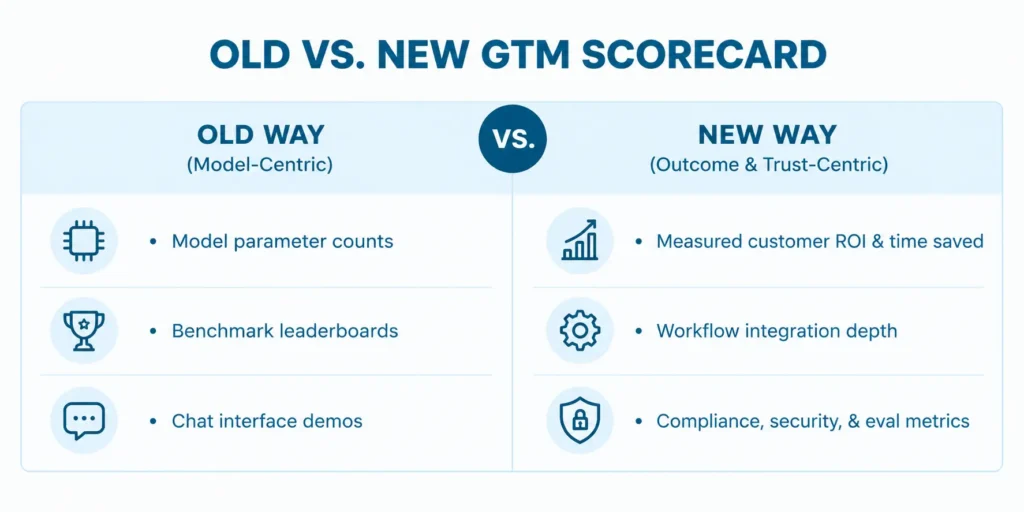
The GTM operational scorecard
To build an outcome-driven GTM engine, marketing leaders should update their evaluation criteria.
Conclusion
The commoditization of foundation models shifts power away from infrastructure providers toward teams that solve real-world operational challenges. Winning enterprise brands will be built by GTM organizations that lead with business outcomes, deep workflow integration, and enterprise-grade trust.
At Wishtree Technologies, we help B2B technology providers build and position production-ready AI platforms.
- – Engineer scalable execution stacks across AWS, Databricks, and Anthropic Claude optimized for cost-per-outcome efficiency.
- – Build custom retrieval engines (RAG) that convert private unstructured data lakes into high-precision context layers.
- – Integrate automated evaluation harnesses, audit logging, and security controls directly into your application stack.
FAQs
Should we ever mention underlying foundation model providers in GTM collateral?
Yes, but keep it as supporting technical detail rather than your primary headline. Reference providers (e.g., Anthropic Claude via AWS Bedrock) in technical whitepapers or security documentation where data residency, encryption, and enterprise compliance matter to IT reviewers.
How do we compete if a competitor advertises access to a newer or larger model?
Shift the conversation to outcomes, proprietary domain data, and trust. A smaller, cost-optimized model backed by proprietary data context and embedded natively into a buyer’s workflow consistently outperforms a generic large model lacking domain context.
How can we quantify enterprise outcomes without over-promising ROI?
Use verified pilot benchmarks, customer case studies, and conservative cost-per-outcome estimates. Highlight measured efficiency gains grounded in real customer production data.