Table of Contents
TL;DR
ELT is now the default approach for modern cloud and lakehouse architectures, while traditional ETL still makes sense for specific workloads that require transformation before data reaches its destination. Zero-ETL reduces unnecessary data movement between systems but does not eliminate the need for transformation, governance, or data quality. In 2026, a hybrid architecture combining ELT, ETL, and Zero-ETL is often the most practical approach, depending on data volume, latency, security, and business requirements.
Executive summary
For a decade, the industry mostly settled on “ELT by default” as cloud warehouses got cheaper and stronger. In 2026, that default is breaking. AI workloads need messy, high‑granularity history, while GDPR‑style privacy regimes and new AI regulations demand strict control over whatever leaves source systems. The real decision is no longer “ETL vs ELT vs Zero‑ETL,” but which combination of them fits each dataset’s sensitivity, latency, and AI needs, what Het Suthar from Wishtree Technologies calls a Purpose‑built pipeline strategy.
Introduction
The old debate of ETL vs. ELT made sense when the main constraint was warehouse compute. Today, the constraints look very different – AI systems that demand messy, high‑granularity history on one side, and GDPR‑style privacy regimes plus new AI regulations on the other.
That’s why my view is simple – there is no longer a “correct” pipeline pattern in isolation, only a pipeline that fits a specific context.
ELT is fantastic for agentic AI, but risky if healthcare customers’ PII is flowing in raw. Zero‑ETL gives real‑time dashboards almost for free, but leaves governance rules to be enforced downstream instead of at the boundary.
This executive guide walks through how to think about ELT, ETL, and Zero‑ETL as a portfolio, and how to design a hybrid data architecture that is AI‑ready, regulation‑ready, and cost‑sane at the same time.
ETL vs. ELT vs. Zero‑ETL – A quick 2026 refresher
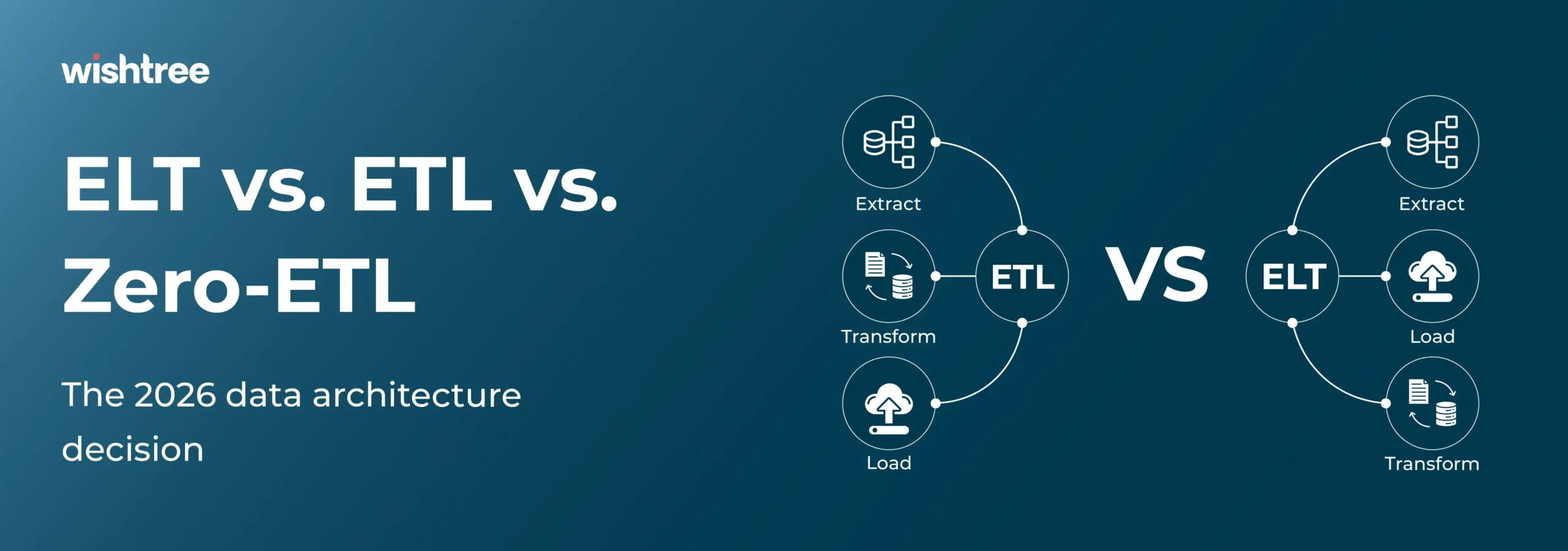
- ETL (Extract, Transform, Load)
Data is cleaned, validated, masked, and reshaped before it lands in the warehouse or lakehouse. ETL historically made sense when warehouse compute was limited and when you needed strict control over what you stored. - ELT (Extract, Load, Transform)
Raw data is loaded into the warehouse or lakehouse first, then transformed using in‑warehouse compute with tools like dbt, Spark, or native SQL engines. This became the cloud‑native default as storage and compute got cheap and elastic. - Zero‑ETL / Managed ELT
Native integrations (for example, Aurora → Redshift, AlloyDB → BigQuery, Snowflake ingestion services) continuously sync operational databases into analytical platforms with minimal custom pipeline code. In practice, Zero‑ETL removes most of the movement plumbing, but transformation, modeling, and governance still happen later.
In 2026, ELT is still the default for cloud‑native AI/analytics platforms, ETL is still necessary for compliance‑sensitive flows, and Zero‑ETL is the emerging choice for operational, low‑latency dashboards.
The 2026 data flow multiverse
Now, I will break Wishtree’s data flows into three paths for you – each optimized for a different business need.
1. The AI‑first path (ELT)
For agentic AI systems, raw data is non‑negotiable. Building AI-ready data infrastructure means preserving the noise – outliers, edge cases, and long‑tail histories that classic ETL workflows would clean away, but models need to learn from.
- Strategy: Load everything into a lakehouse (Snowflake, Databricks, BigQuery, Redshift) first, then transform as needed.
This pattern is central to lakehouse architecture, where raw data lands in low‑cost object storage before being transformed for analytics, preserving full fidelity for AI workloads that traditional warehouses would price out.
- Why it works:
- Preserves full event history for feature engineering and retraining.
- Lets you evolve transformation logic as new AI use cases emerge.
- Avoids “over‑cleaning” that kills model performance.
- Best for: Predictive analytics, recommendations, fraud detection, user modeling, LLM fine‑tuning, and any workload where patterns hide in subtle details.
2. The compliance‑first path (ETL)
Regulated domains – healthcare, finance, insurance clients – cannot stream raw PII/PHI directly into a general‑purpose warehouse without strong controls.
- Strategy: Mask, anonymize, encrypt, and validate before data leaves operational boundaries.
- Why it works:
- Keeps raw PII/PHI in tightly controlled systems.
- Ensures analytical environments only see safe, policy‑compliant data.
- Aligns with GDPR/AI‑Act style requirements to protect personal data at collection and transfer.
- Best for: Healthcare analytics, financial reporting, insurance, public sector, and any workload governed by HIPAA, GDPR/“GDPR 2.0”, PCI DSS, or AI‑specific laws.
3. The real‑time path (Zero‑ETL)
Leaders want live dashboards with deployment health, sprint health, inventory, funnel drop‑off, in seconds.
- Strategy: Use native Zero‑ETL integrations (for example, Aurora → Redshift, Datastream → BigQuery, Snowflake ingestion) to stream operational changes into analytics automatically.
- Why it works:
- Near real‑time sync from source to warehouse with minimal ETL code.
- Great for monitoring and operational decisioning.
- Reduces the engineering cost of custom CDC pipelines.
- Best for: Live operational dashboards, customer 360s, fraud signals, and anything where “time from event to insight” is a competitive edge.
For organizations requiring sub‑minute latency without custom CDC pipelines, real-time data pipelines built on streaming platforms complement Zero‑ETL for high‑volume, low‑latency use cases.
Wishtree’s insight: Zero‑ETL simplifies ingestion, not modeling. We still need proper schemas, quality checks, and business logic. Those responsibilities just move closer to the query or consumption layer.
Why ELT became the AI‑ready default
Modern vendors and practitioners explicitly call ELT the default architecture for cloud platforms in 2026.
Three drivers:
1. Warehouses are compute engines now
Snowflake, BigQuery, Redshift, and Databricks provide scalable compute for in‑place transformations. Effective cloud data warehouse optimization ensures these ELT workloads run cost‑effectively while preserving raw history for AI.
2. AI/ML workflows need raw and historical data
AI data privacy guides repeatedly warn that aggressive aggregation and filtering can remove the very signals models rely on. ELT preserves raw logs, event streams, and detailed history while letting you add higher‑level models (marts, features, aggregates) on top.
3. Iteration speed
With ELT, analysts and data engineers can adjust transformations inside the warehouse without touching upstream connectors. That shortens the feedback loop for new metrics, experiments, and AI features.
So for AI‑first companies, ELT is the default, but not the only pattern. It wins on flexibility and AI readiness, but loses on compliance and storage cost.
The rise of Zero‑ETL: managed movement vs. true transformation
Major cloud providers heavily promote Zero-ETL (and managed ELT) integrations – such as Amazon Aurora to Redshift or Google AlloyDB to BigQuery, to seamlessly replicate transactional data into analytical platforms.
However, Zero-ETL eliminates ingestion friction, not data engineering responsibilities.
| What Zero-ETL solves (Managed Ingestion) | What Zero-ETL does not solve (Governance & Modeling) |
| Eliminates custom pipeline plumbing: Removes the need to write and maintain bespoke extraction/loading code. | Data modeling & schema design: Does not structure raw operational tables into enterprise-ready data marts. |
| Near real-time availability: Streams transactional updates continuously into the warehouse with sub-minute latency. | Business logic enforcement: Does not apply business transformations, metrics calculation, or semantic rules. |
| Lowers maintenance overhead: Minimizes failure points tied to brittle Change Data Capture (CDC) infrastructure. | Governance & data masking: Does not automatically enforce PII masking, data scrubbing, or compliance rules. |
The Wishtree takeaway: In practice, Zero-ETL provides Managed Movement. It accelerates how fast data arrives in your warehouse, but modeling, quality checks, and compliance logic must still be engineered downstream before that data is analytics-ready.
Where ETL still matters (and will continue to)
Contemporary guides stress that despite ELT’s rise, ETL remains mandatory for sensitive, edge, and legacy contexts.
Typical ETL responsibilities in 2026:
- Masking/anonymizing information like PII and PHI at the source boundary.
- Encrypting sensitive fields prior to transfer or storage.
- Running compliance checks (schema validation, field presence, consent flags).
- Performing data quality enforcement so only “safe” records move forward.
- Aggregating where row‑level exposure isn’t justified.
Real‑world example: A fintech lending platform might use ETL pipelines to hash and tokenize customer identifiers, strip out full PANs, and aggregate transactional behavior before sending it to analytics environments, while still relying on ELT inside the warehouse to support credit‑risk models and fraud detection.
In this setup, ETL creates a hardened governance boundary, while ELT inside the warehouse keeps the data flexible enough for advanced modeling and exploration.
The Wishtree decision framework for 2026
Here is my rubric for CTOs and CDOs choosing pipeline patterns.
| Business need | Use this pattern | Wishtree advantage |
| High‑scale AI/ML | ELT | Keeps full raw context for feature engineering and retraining |
| Strict data privacy (HIPAA/GDPR) | ETL | Enforces masking/encryption before cloud, reducing regulatory risk |
| Live operational reporting | Zero‑ETL | Seconds‑level latency from “event” to “insight” with minimal ETL code |
| Complex business logic | Hybrid | Sensitive fields cleaned at entry, heavy transforms done in‑warehouse |
The trick is to map data class → pipeline pattern.
Before designing pipelines, assess your data readiness for AI – understanding where sensitive data lives, what governance is required, and which datasets need full historical preservation for model training.
The 2026 data pipeline decision tree
Use this simplified decision flow:
- The regulatory gate
Is the data highly sensitive (PII, PHI, PCI, regulated regions)?- YES → ETL. Mask/encrypt before any cloud analytics.
- NO → Step 2.
- The latency gate
Do you need near real‑time operational visibility (inventory, live sales, SLAs)?- YES → Zero‑ETL. Use native streaming/replication.
- NO → Step 3.
- The AI & ML gate
Will this data power AI agents or predictive models?- YES → ELT. Preserve raw “noise” in a lakehouse; transform for features.
- NO → Standard ELT or lightweight ETL for BI and reporting.
This mirrors 2026 guidance – ETL for compliance and constrained environments, ELT for cloud AI, Zero‑ETL for real‑time analytics.
Wishtree’s architecture comparison (ETL vs. ELT vs. Zero‑ETL)
| Feature | ETL (Security‑first) | ELT (AI‑first) | Zero‑ETL (Speed‑first) |
| Data quality | High at entry (strict checks) | Depends on downstream models | Raw at arrival, must be handled later |
| AI readiness | Lower (some signal removed) | High (full raw history preserved) | Medium (fast, but requires modeling before AI use) |
| Compliance | High (PII processed before cloud) | Lower if raw PII is stored without controls | Low unless combined with governance in warehouse |
| Storage cost | Lower (filtered, curated data) | Higher (store “everything”) | Tied to warehouse, similar to ELT |
| Latency | Medium (batch windows) | Medium–high (depends on job cadence) | Low (near real‑time sync) |
| Engineering effort | High (custom pipelines) | Medium (dbt/Spark in‑warehouse) | Low for ingestion, modeling still required |
| Best for | Healthcare, finance, heavily regulated | AI/ML, data science, exploratory analytics | Live dashboards, ops monitoring, customer 360 in real time |
The hybrid data architecture emerging in 2026
Recent industry write‑ups explicitly note that the most mature platforms now run hybrid architectures.
Typical hybrid:
- ETL for regulated ingestion paths (customer PII, patient records, payments).
- ELT inside the warehouse or lakehouse for analytics and AI.
- Zero‑ETL for specific high‑value, low‑latency surfaces like operations and product analytics.
Wishtree example:
- A healthcare SaaS uses ETL to anonymize and encrypt patient data before cloud ingestion (HIPAA/GDPR compliance).
- Inside the secure warehouse, they use ELT to build readmission‑risk models and cohorts.
- For “bed occupancy now” dashboards, they use Zero‑ETL from the EHR system to keep operations in sync.
Teams that embrace this hybrid view are better positioned to support evolving AI workloads and stricter regulations at the same time.
The data architecture health check – 5 questions
- How do you handle sensitive data (PII/PHI/PCI)?
A) Masked/encrypted before leaving source (ETL)
B) Loaded raw, filtered at query time (ELT)
C) We are not sure – everywhere it lives? - What is your latency from transaction to insight?
A) Seconds/minutes for critical paths (Zero‑ETL)
B) Hours/days via batch jobs
C) We do not track it - How are AI/ML workloads fed?
A) Raw ELT pipelines with full history preserved
B) Pre‑aggregated/cleaned data only
C) “Whatever is available” – not designed intentionally - Do you run one pattern or multiple?
A) Hybrid – different patterns by data class/use case
B) One pattern for everything (usually ELT or ETL)
C) Ad‑hoc pipelines with inconsistent standards - How is governance enforced?
A) Policy‑as‑code inside ETL/ELT jobs
B) Manual reviews and documentation
C) Mostly aspirational – still being formalized
Scoring
- Mostly As – Hybrid architecture leader. You are balancing compliance, AI readiness, and speed. Data is indeed a strategic asset for you.
- Mostly Bs – Modernization gap. You have modern pieces, but not yet aligned to AI and regulatory realities.
- Mostly Cs – Data debt alert. Your data platform is likely slowing AI work and raising compliance risk.
Build your hybrid data platform with Wishtree
Wishtree does not push a single pattern. We help you design a purpose‑built, hybrid data platform.
- Data architecture audit – Map current flows, bottlenecks, regulatory risk, and AI readiness.
- Hybrid pipeline design – Decide which data flows use ETL, which use ELT, and where Zero‑ETL makes sense.
- Compliance‑as‑Code – Encode masking, encryption, and retention policies directly into pipelines.
- AI‑ready ELT platforms – Build warehouses/lakehouses that keep raw history available for ML.
- Zero‑ETL integration – Wire up native syncs for real‑time dashboards and operational analytics.
- Team training – Bring your data engineers and platform teams up to speed on 2026 patterns and tools.
Is your data AI-ready, or just stored?
Schedule a 30-minute data strategy review with the Wishtree team. We will assess your current pipelines and build a roadmap to a hybrid, AI-ready data architecture.
FAQs
1. What is the single biggest mistake organizations make with data pipelines in 2026?
The biggest mistake is choosing one architecture and forcing all data through it. ELT is excellent for AI but terrible if you must keep PII out of your warehouse. ETL is essential for regulated data but can destroy ML signal. Zero‑ETL is fast but provides almost no built‑in governance. The winning strategy in 2026 is hybrid. Simply match the pipeline pattern to the data type and use case, not the other way around.
2. Does Zero‑ETL mean I do not need data engineers anymore?
No. Zero‑ETL reduces the engineering cost of ingestion – getting data from A to B via managed, native syncs. It does not eliminate the need for data modeling, transformation logic, data quality checks, governance, or performance tuning. Those responsibilities simply move downstream to the warehouse and consumption layers, where skilled data engineers are still critical.
3. How does over‑cleaning data kill AI performance?
AI models, especially deep learning systems, often extract signal from what looks like “noise” – outliers, rare edge cases, subtle variations in behavior over time. When you over‑clean – aggressively dropping outliers, over‑aggregating, or filtering heavily before storage – you strip away these patterns and leave models with a sanitized but shallow view of reality. ELT keeps raw history so AI can see the full picture.
4. What are the regulatory drivers for ETL in 2026?
Updated privacy regimes (GDPR evolutions, CPRA) and AI‑specific regulations (such as the EU AI Act) demand stricter control over how personal and high‑risk data is moved and stored. Many organizations must ensure PII, PHI, and payment data are masked, encrypted, or minimized before they hit analytical platforms. ETL with policy‑driven masking and validation at the source boundary is increasingly a legal requirement, not just a best practice.
5. Can I use all three patterns (ETL, ELT, Zero‑ETL) together?
Yes, and in 2026, the most mature organizations do exactly that.
A typical hybrid pattern – Zero‑ETL for low‑latency operational dashboards, ETL for regulated customer and financial data, and ELT for raw logs and event streams feeding analytics and ML.
6. How do I decide which data goes where?
Start with classification:
- Is the data sensitive (PII/PHI/PCI)? → ETL with masking and encryption.
- Does it power real‑time decisions? → Zero‑ETL from source to warehouse.
- Is it for AI/ML or exploratory analytics? → ELT into a lakehouse with raw preservation.
- Is it traditional BI? → Usually ELT, though lightweight ETL is fine if compliance demands it.
7. What is the cost difference between these architectures?
- ETL: Higher upfront engineering and maintenance cost, but lower storage and tighter control (you only store curated data).
- ELT: Lower pipeline engineering cost and maximum flexibility, but higher storage and potential governance overhead (you store “everything”).
- Zero‑ETL: Low ingestion cost via managed services, but you pay in downstream modeling/compute at query time and must add governance in the warehouse.
8. How does this connect to AI agents?
AI agents need long‑term, high‑granularity memory. ELT pipelines that preserve raw historical data form the memory layer those agents read from – clickstreams, events, logs, and de‑identified histories. If you over‑clean or aggregate before storage, agents get a blurred summary instead of the detailed history they need for nuanced reasoning.
9. What is the role of dbt in this architecture?
dbt is the de‑facto standard for managing the T in ELT. It runs transformations inside your warehouse, turns raw tables into modeled marts, adds tests, and documents lineage.
In a hybrid setup, upstream ETL handles sensitive‑data policies and initial shaping, while dbt focuses on analytics and AI‑ready models on top of what’s been safely loaded.
10. How can Wishtree help my organization implement a hybrid data architecture?
Wishtree offers Data architecture health checks to assess current pipelines and risks, Hybrid pipeline design to define which flows use ETL, ELT, or Zero‑ETL, and Compliance‑as‑Code implementations to embed governance into transformations. We also design AI‑ready ELT lakehouses, integrate Zero‑ETL paths, and train your teams on modern, hybrid data engineering, so your platform is not just storing data, but actually AI‑ready and compliant for 2026 and beyond.