Table of Contents
TL;DR
“Which model is best” is the wrong question. The right one is which model fits this specific workflow, with its own data, latency needs, and risk tolerance. Most large enterprises will end up running a portfolio, not one model, since a finance team’s document analysis and a support team’s response drafting have almost nothing in common. The piece lays out a five-part way to evaluate any model (business, technical, governance, economic, and strategic fit), warns against multi-model sprawl for its own sake, and argues a model gateway solves routing, not strategy. The real deliverable isn’t picking a winner, it’s a decision record for each workload that says why a model was chosen and what would change that choice.
Executive summary
By August 2026, choosing an AI model is no longer a one-time procurement decision. This blog presents a practical framework for evaluating Claude as part of an enterprise AI portfolio, without turning model selection into a benchmark contest or creating unnecessary platform complexity.
Introduction
The model-selection conversation often starts with the wrong question:
“Which is the best model?”
That question sounds strategic, but it rarely helps an enterprise make a good decision. A model that performs well for software development may not be the right choice for document-heavy operations. A model that works well for an internal assistant may not be suitable for a regulated workflow or a customer-facing product.
The choice also involves more than model quality. Enterprises need to consider data access, security review, latency, cost, observability, deployment options, integration effort, and the skills required to operate the system.
Claude can be used through enterprise products or integrated into applications and services through the Claude Platform. Anthropic presents both paths as part of its enterprise offering – secure access for employees and API-based development for teams building products, agents, and workflows.
That flexibility creates opportunity, but it also creates a design responsibility. Enterprises need a model strategy that explains where Claude fits, what it should power, and when another model or approach is more appropriate.
Stop treating models like competitors
Model comparisons often reduce the decision to benchmark scores, context windows, or headline capabilities.
Those measures can be useful during technical evaluation. They are not enough to make an enterprise architecture decision.
A production model must perform inside a specific environment:
- – With the organization’s data
- – Through its identity and access controls
- – Within its latency and cost limits
- – Under its governance requirements
- – Alongside its existing applications and data platforms
- – With a clear owner for evaluation and ongoing improvement
This is why a model can look strong in a general benchmark and still be a poor fit for a particular business process. The enterprise is not buying an abstract score. It is operating a workflow.
The better question is:
Which model is the right fit for this job, in this environment, with these consequences?
Build a portfolio
Most large enterprises will not have one AI requirement. They will have several.
A finance team may need document analysis. A software team may need code assistance. Customer operations may need summarisation and response drafting. Risk teams may need evidence extraction and review support. Product teams may need research and analysis.
These workloads may differ across five important dimensions:
| Dimension | Why it matters |
| Reasoning depth | Some tasks need interpretation across lengthy or ambiguous material |
| Response speed | Interactive workflows may require a quick response |
| Cost profile | High-volume tasks can make small efficiency differences significant |
| Risk level | Sensitive or consequential use cases need stronger controls and review |
| Integration needs | Some workflows require tools, APIs, connectors, or structured outputs |
A sensible portfolio may therefore include a primary model for certain workflows, another model for specialised tasks, and deterministic software for processes that do not need generative AI at all.
The goal is appropriate capability without unnecessary operational overhead.
Where Claude may fit
Evaluate Claude against the workflow. Do not select it simply because it is the newest addition to the technology stack.
Potential areas for evaluation include:
- – Long-form analysis where the system must work through substantial business context
- – Document-heavy workflows involving summarisation, comparison, or drafting
- – Software engineering and code-related tasks
- – Knowledge workflows where responses need to be grounded in approved sources
- – Enterprise assistants that combine reasoning with connectors and internal context
- – Product or agent workflows that require controlled tool use
Anthropic’s enterprise materials position Claude across business applications, developer tools, and API-based product development, with enterprise controls such as role-based access, audit logs, data retention controls, and usage visibility available in its enterprise offering.
That does not mean every organization should use every Claude capability. It means evaluation can cover both employee-facing use cases and embedded AI applications, depending on the enterprise’s needs.
The five-part evaluation
A useful model evaluation should go beyond “Which answer sounds better?” It should test the full operating environment.
1. Business fit
Start with the work the organization wants to improve.
Define:
- – The current process
- – The people involved
- – The point of friction
- – The expected improvement
- – The cost of leaving the process unchanged
A model that performs impressively but does not improve a meaningful process is not creating business value.
2. Technical fit
Evaluate how the model works with the existing architecture.
Questions include:
- – How will data be retrieved and passed to the model?
- – Can responses be returned in the format the application needs?
- – How will the workflow handle tool use or external actions?
- – What latency is acceptable?
- – How will failures and fallbacks work?
- – Can the system be tested before every release?
This is where architecture matters more than a product demonstration. The model is one component in a wider system.
3. Governance fit
The model must fit the organization’s control environment.
Review:
- – Data handling and retention requirements
- – Identity and access management
- – Audit and monitoring capabilities
- – Human review requirements
- – Regional or industry-specific obligations
- – Incident response and change management
A model that produces high-quality output but cannot pass the organization’s security or compliance review is not production-ready for that use case.
4. Economic fit
Model cost is only one part of the business case.
The complete cost may include:
- – API or subscription usage
- – Data preparation and retrieval
- – Application and integration work
- – Evaluation and monitoring
- – Security and compliance review
- – Human review of outputs
- – Model changes and ongoing maintenance
- – Training and adoption
An apparently inexpensive model may become expensive if it requires more retries, heavier post-processing, or extensive human correction.
The right measure is not simply cost per request. It is cost per useful outcome.
5. Strategic fit
Finally, consider how the choice affects the enterprise over time.
Ask:
- – Does the model support the company’s long-term AI direction?
- – Can the workflow be moved or adapted if requirements change?
- – Are prompts, evaluations, and application logic portable?
- – Can the organization route different workloads appropriately?
- – Does the architecture create avoidable vendor dependency?
- – Will the team be able to operate the system two years from now?
Strategic flexibility does not mean refusing to commit to a platform. It means keeping the important application and data patterns under the enterprise’s control.
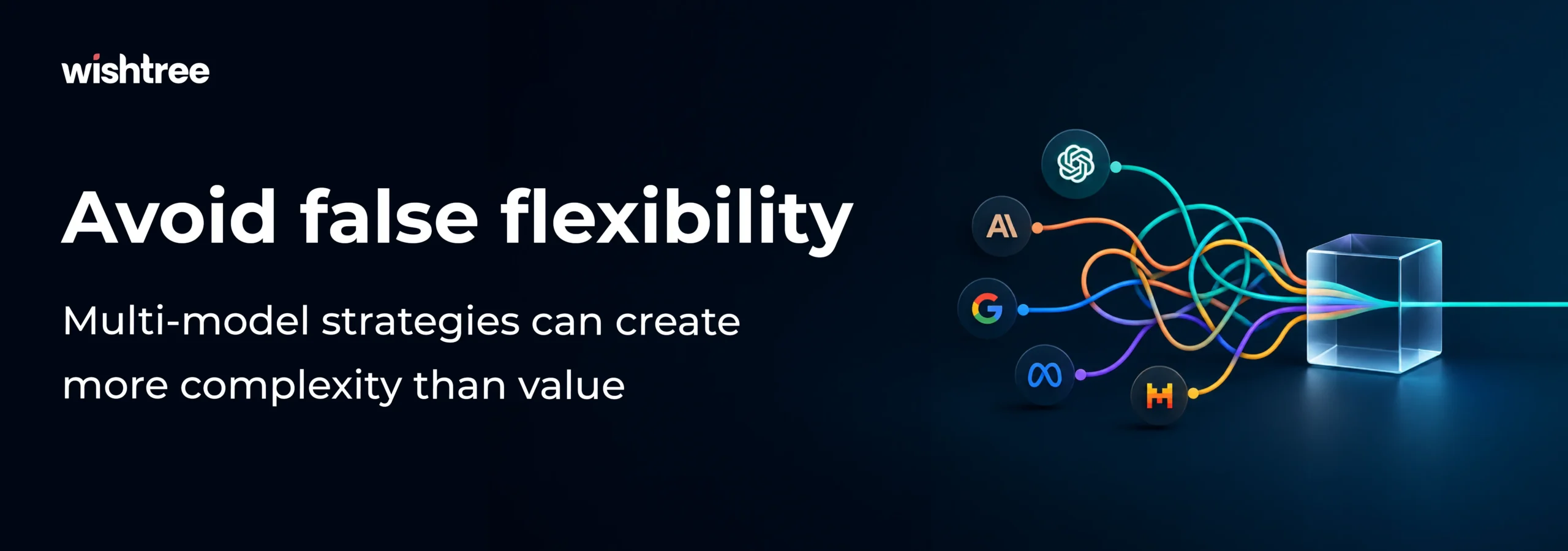
Avoid false flexibility
Multi-model strategies can reduce dependence on a single provider. They can also create a new form of complexity.
Every additional model may introduce:
- – Another API or deployment surface
- – Different behaviour and output formats
- – Separate evaluation requirements
- – More complex monitoring
- – Additional security and procurement reviews
- – More skills for engineering and operations teams to maintain
You must define a deliberate level of standardisation.
A practical approach is to establish:
- – One approved enterprise AI architecture
- – A small number of model providers or deployment options
- – Shared evaluation and observability patterns
- – Common security and access controls
- – Clear criteria for adding another model
Model diversity should solve a real business or technical problem. It should not become a status symbol for architectural sophistication.
The model gateway is not the strategy
Some enterprises respond to model uncertainty by building a model gateway. A gateway can help with routing, access control, usage tracking, fallbacks, and provider abstraction.
It does not, by itself, answer the important questions:
- – Which workflows should use generative AI?
- – What does acceptable quality mean?
- – Who owns the evaluation set?
- – What data can each workflow access?
- – When should a human review the output?
- – Which model is approved for which risk tier?
- – What happens when a model update changes behaviour?
A gateway is an enabling layer. It should support the model strategy, not substitute for one.
The same applies to retrieval, agent orchestration, and prompt management. These are useful capabilities, but they have value only when connected to a specific workflow and measurable business outcome.
Create a decision matrix for each workload
Instead of choosing a single enterprise-wide winner, create a short decision record for each priority workload.
| Decision area | Questions to document |
| Use case | What task is being improved, and for whom? |
| Model role | Is the model drafting, analysing, retrieving, recommending, or acting? |
| Data | What information is required, and who may access it? |
| Evaluation | How will quality, safety, speed, and cost be tested? |
| Controls | What human review, logging, and approval are required? |
| Economics | What is the cost per useful outcome? |
| Operating model | Who owns the workflow after launch? |
| Scale path | Which adjacent use cases can reuse the same foundation? |
This record should be revisited when the workflow, model, data sources, or business risk changes.
It also gives senior leaders a better basis for approving investment. They can see not only which model was selected, but why it was selected and what evidence would justify changing that decision.
A practical portfolio structure
An enterprise AI portfolio can be organised into three broad categories.
1. Core workloads
These are important, repeatable workflows where the organization has clear data, ownership, and success measures. They deserve production investment and reusable architecture.
2. Experimental workloads
These have potential but need more evidence. They should run in controlled environments with defined time limits and exit criteria.
3. Non-AI workloads
Some processes are better served by rules, search, analytics, automation, or conventional software. Forcing a generative model into these workflows adds cost without improving the outcome.
This classification prevents every AI idea from becoming a permanent platform commitment. It also helps teams invest more confidently in use cases that have earned the right to scale.
Choose for the work ahead
The strongest AI strategy in 2026 is unlikely to be built around a single model or a long list of model licences. It will be built around a clear portfolio of business workflows, each with an appropriate level of capability, control, and investment.
Claude may be the right choice for some of those workflows. The important step is to establish where it fits and prove that fit under real operating conditions.
Wishtree Technologies helps enterprises evaluate and implement AI capabilities across their existing cloud, data, and application environments. We, as part of the Claude Partner Network, connect model decisions to data foundations, governance, integration, observability, and measurable business outcomes.
If your organization is comparing models without a clear workload strategy, begin with the portfolio. List the workflows, define the outcomes, classify the risks, and evaluate each model against the work it must actually perform.
Contact us today.
Frequently Asked Questions (FAQs)
Should Claude replace the other models an enterprise already uses?
Not automatically. The right approach is to evaluate Claude against specific workflows and compare the complete operating requirements, including quality, governance, integration, economics, and maintenance.
Is a multi-model strategy always better?
No. It can provide flexibility and task-specific optimisation, but it can also increase operational complexity. Use multiple models where the difference creates measurable value.
How should enterprises compare models?
Use representative business tasks and production-like data, not only public benchmarks. Measure output quality, correction effort, latency, cost, failure modes, governance requirements, and user acceptance.
What does model portability really mean?
Portability does not mean moving an application with no changes. It means keeping prompts, evaluation sets, data contracts, business logic, tool definitions, and observability patterns sufficiently separate from one model so that the enterprise retains meaningful options.
Where should Wishtree fit in the model-selection process?
Wishtree can help assess the workload, design the surrounding data and application architecture, establish evaluation and governance patterns, and implement the chosen model within the enterprise’s cloud and data environment. The decision should remain tied to the customer’s business and technical requirements.