
TL;DR
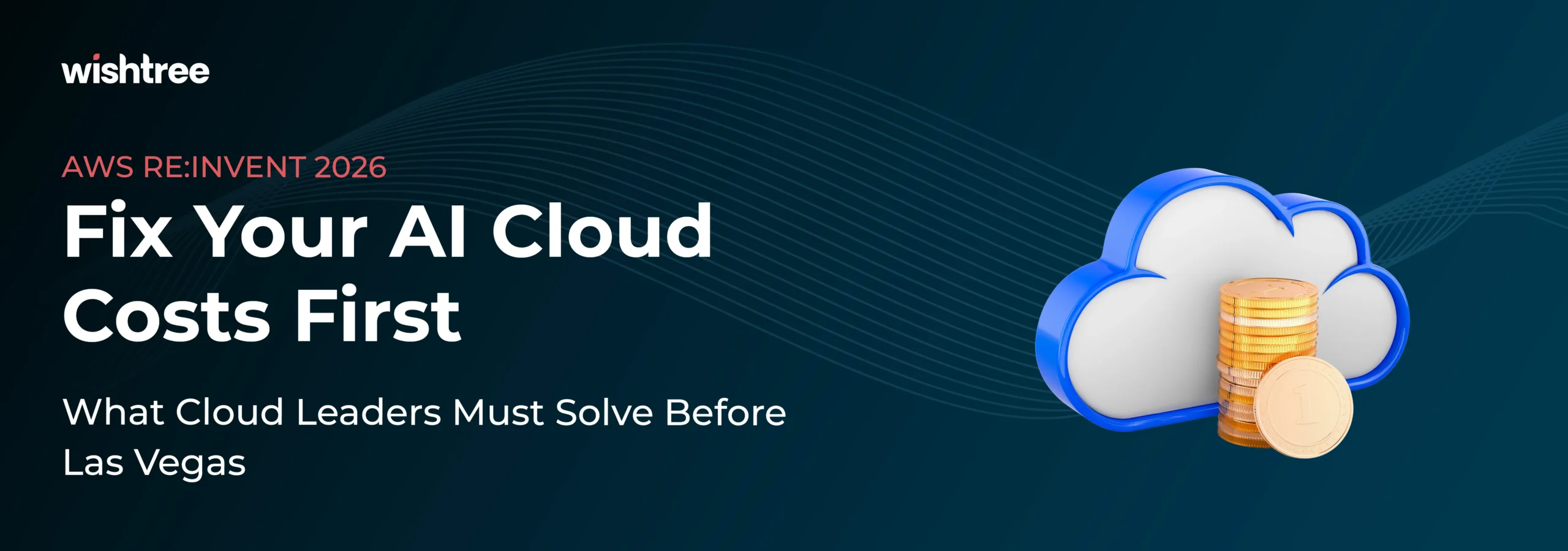
Most AWS AI bills grow because of architecture, not usage. Fix the foundation before re:Invent’s new services add more layers on top.
- – Route simple prompts to smaller models; save frontier models for complex reasoning.
- – Stop copying data between S3, warehouses, and vector databases; unify it in a Delta Lake lakehouse.
- – Enforce permissions once at the data layer with Unity Catalog, not in every tool.
- – New AWS services only pay off on a clean, cost-efficient data foundation.
Introduction
With AWS re:Invent 2026 returning to Las Vegas in November 2026, engineering leads and cloud architects are building their event schedules.
If you look at the executive agendas across enterprise tech teams right now, the primary challenge heading into late 2026 is: How do we optimize compute spend, unify fragmented vector data, and stop cloud infrastructure bills from spiraling as AI models enter daily production?
Over the past year, many companies connected Amazon Bedrock or SageMaker to their internal data. Then user traffic grew, and so did the friction, and cloud costs started climbing. The result was unpredictable token usage, redundant cross-region transfers, and siloed security policies.
Now CTOs want structural answers to AWS AI cost optimization, not more tools.

Taming the hidden costs of continuous compute
The biggest surprise for teams scaling AI on AWS? The gap between staging costs and production reality.
In a sandbox, running queries against top-tier LLMs through Amazon Bedrock costs very little. Once thousands of users start firing continuous prompts, the costs stack up across three layers:
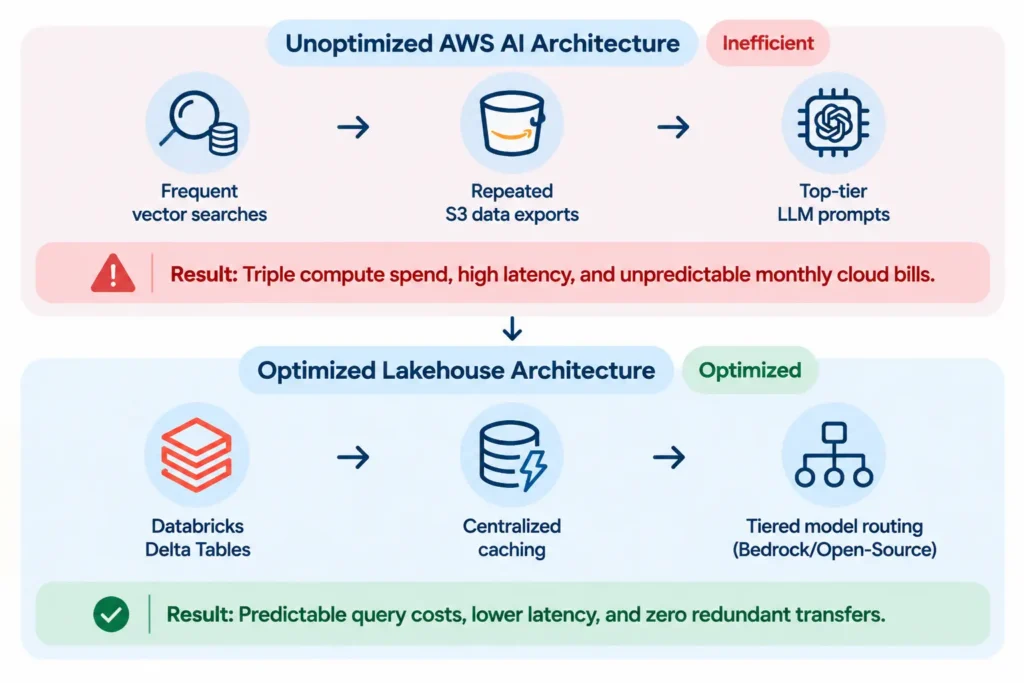
To prevent budget blowouts, teams serious about AWS AI cost optimization use intelligent prompt routing. Simple categorization tasks go to smaller, fine-tuned open-weight models. Expensive frontier models are reserved strictly for complex reasoning.
Eliminating data movement between cloud silos
A massive contributor to inflated AWS bills is unnecessary data motion.
When your transactional data sits in one warehouse, your documents live in Amazon S3. Your embeddings are copied into a niche third-party database. Every AI interaction means moving files across network boundaries.
The fix heading into 2027: unify storage under one lakehouse architecture.
Organize your enterprise data on AWS with open table formats – Delta Lake managed through Databricks. And your developers can query live operational data right where it sits.
No more exporting, formatting, and duplicating massive datasets every time you deploy a new AI agent or RAG app.
Unifying Governance with Databricks Unity Catalog on AWS
Piling on cloud services without a centralized permission model will get you compliance bottlenecks. You cannot avoid policy drift if your security team has to manually set identity rules in AWS IAM, individual vector stores, and app frontends.
This is where pairing Databricks with your AWS foundation changes the operational equation.
Enforce access controls through Databricks Unity Catalog on top of your AWS storage (S3), and security rules apply right at the root data layer:
- – User permissions follow the employee across every tool – whether they are running an SQL query or talking to a Bedrock-powered assistant.
- – Sensitive fields like PII or financial records are masked automatically before they ever reach the model context.
- – Audit logs track every query, so legal and compliance see exactly how enterprise data is being used.
Security teams preparing for the event should also read our guide to AI threat detection for your SOC on AWS.
Preparing your cloud architecture for what is next
AWS re:Invent 2026 will undoubtedly announce exciting new capabilities, faster compute instances, and deeper automation tools. But new services can only deliver ROI if your underlying data foundation is clean, secure, and cost-efficient, and if your cloud optimization practice can keep pace with every new instance type you adopt.
At Wishtree, we partner with enterprise leaders to modernize AWS cloud architectures, streamline data engineering, and deploy production-ready software that scales predictably.
Scale your cloud engineering capacity
If your internal team needs specialized AWS or Databricks data engineers to optimize your pipelines before year-end, hire experienced Wishtree developers in 48 hours.
Validate your infrastructure risk-free
Want to see how your current AWS data pipelines handle heavy concurrent AI workloads before committing to a major overhaul? Start a risk-free trial with our engineering team today.
Frequently Asked Questions (FAQs)
Why are our AWS generative AI workloads costing more than expected in production?
Production costs balloon when architectures rely on unoptimized compute – sending simple queries to high-cost LLMs, or constantly exporting data across network boundaries between S3, vector databases, and third-party tools. Effective AWS AI cost optimization starts by fixing these two patterns.
How does Databricks running on AWS help reduce overall cloud spend?
Databricks unifies data storage in open formats right inside your Amazon S3 environment. That means no duplication fees, optimized query compute, and vector searches you can cache efficiently. Without paying for separate third-party database licenses.
Do we need to rewrite our AWS IAM policies to implement Databricks Unity Catalog?
No. Unity Catalog integrates directly with AWS IAM and identity providers (like AWS IAM Identity Center or Microsoft Entra ID). It simplifies security by enforcing governance at the data layer, reducing the need for complex, custom IAM bucket policies.
How can Wishtree help us prepare our AWS environment for re:Invent 2026?
We step in as an execution partner to audit your current cloud setup, clean up fragmented data pipelines, set up automated governance, and optimize your compute architecture. Contact our team today to discuss your roadmap.