
TL;DR
Cloud spend becomes manageable once finance treats it as a variable cost tied to business volume, not a fixed IT line item.
- – Measure cost per transaction, per active user, or per order, not just the total monthly bill.
- – The biggest waste comes from oversized servers, forgotten storage, and data transfer fees.
- – Skip across-the-board cuts. Remove waste first, then optimize pricing, then unify storage.
- – Mapping AWS spend to COGS gives finance clear margin visibility and predictable unit costs.
Introduction
For most CFOs, the monthly AWS bill is an exercise in frustration. What started as a flexible, pay-as-you-go promise has turned into an unpredictable, multi-layered expense that grows faster than revenue, with industry research showing nearly a third of cloud spend is wasted.
Most executive teams treat cloud spend like a static IT asset, not a dynamic variable cost tied to cloud unit economics. And that is the problem.
Want to turn cloud from a growing cost center into a driver of gross margin? Finance leaders have to change how they govern AWS spend.
Move from gross spend to cloud unit economics
A total dollar figure at the bottom of a monthly cloud invoice tells you very little about financial efficiency. To establish true visibility, CFOs must evaluate spend through unit economics:
- – Financial Services: What is your cloud infrastructure cost per completed transaction?
- – SaaS & Tech Platforms: What is your cloud compute cost per active monthly user?
- – Logistics & Retail: What is your data processing cost per order fulfilled?
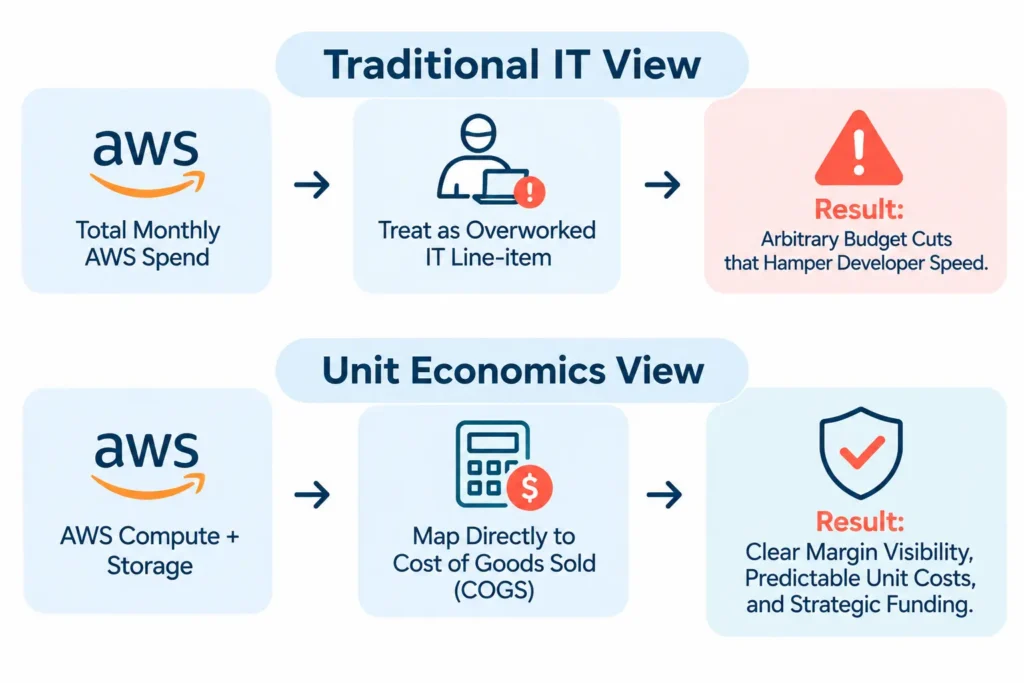
When you connect cloud spend directly to business volume through cloud unit economics, you can immediately tell whether a spend increase is healthy revenue growth or operational waste.
Eliminate the three common waste patterns
Cloud waste happens through hundreds of small, unmonitored operational habits across product squads.
- Engineering teams routinely request oversized virtual servers during development and forget to downsize them for production workloads.
- System logs, temporary database backups, and unattached storage volumes continue billing month after month long after projects are completed.
- Moving uncompressed datasets between different cloud availability zones or exporting data across network boundaries creates silent fee spikes, one of the hidden drivers behind rising AI costs on AWS.
With automated governance tools such as open table formats managed through Databricks on AWS, finance and engineering teams query data in place.
That means no expensive file transfers and no duplicate storage.
Establish a prioritized action plan
Arbitrary mandates like “cut cloud spend by 15% across the board” usually backfire. They slow down product development, frustrate engineers, and never fix the underlying structural waste.
Finance and tech leads need a prioritized framework.
- – Start with waste. Decommission idle assets, kill orphaned storage volumes, and set automated instance scheduling for non-production environments.
- – Then optimize what is left with cloud optimization services that cover reserved instances, savings plans, and centralized query caching for high-volume database workloads.
- – Finally, unify. Move storage under a single lakehouse architecture to eliminate duplicate third-party licenses and build an AI-ready data architecture.
Turn your AWS spend into a growth advantage
Optimizing cloud infrastructure, whether in-house or through AWS managed services, frees up wasted capital you can reinvest in initiatives that drive revenue.
At Wishtree, we work alongside CFOs, CIOs, and finance leaders to improve AWS cost management, build cloud visibility, cut waste, and align infrastructure spend with business value.
Schedule your AWS Profitability Review
We offer a focused, no-obligation review of your current AWS spend, major cost drivers, and practical optimization opportunities. We present our findings as concrete potential savings and prioritized actions.
Book an AWS Profitability Review with us today.
Frequently Asked Questions (FAQs)
How does an AWS Profitability Review differ from a standard IT cloud audit?
A standard IT audit focuses strictly on technical server configurations. Our profitability review evaluates spend through an executive lens – mapping costs directly to business unit metrics, gross margins, and practical financial optimization opportunities.
Will optimizing our AWS spend require rebuilding our entire application?
No. The majority of cloud savings come from configuration adjustments, rightsizing compute instances, eliminating orphaned storage, and implementing intelligent data caching, all without touching core application code.
How does pairing Databricks with AWS help control financial predictability?
Databricks runs on open storage formats right inside your Amazon S3 environment. Centralize query compute and enforce access governance in one place, and you stop paying for duplicate database licenses and cross-network transfer fees.
How quickly can Wishtree help us evaluate our cloud financial setup?
We can begin immediately. Our executive team can conduct an initial scoping conversation and deliver a prioritized action plan within days. Contact our team today to get started.