
TL;DR
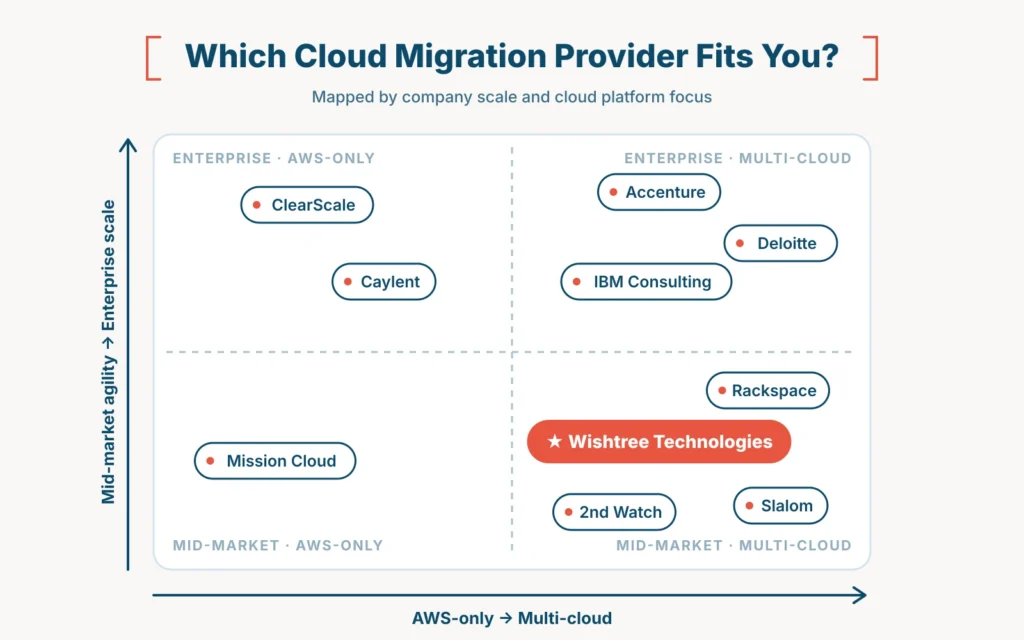
Picking the wrong cloud migration partner is one of the most expensive mistakes a US business can make in 2026. We reviewed ten leading cloud migration companies on hyperscaler partnerships, migration methodology, security and compliance depth, industry experience, post-migration support, and engagement flexibility. The right choice depends less on brand size and more on your workloads, your target cloud, and how much modernization you want along the way.
- – Best overall for mid-market and growing enterprises: Wishtree Technologies, especially for Azure-to-AWS and on-premises-to-AWS moves
- – Best for global, multi-year transformation: Accenture, Deloitte, IBM Consulting
- – Best for long-term managed multi-cloud: Rackspace Technology, 2nd Watch
- – Best for business-led, local consulting: Slalom
- – Best AWS-only specialists: Caylent, Mission Cloud, ClearScale
- – Check before you sign: partner tier, a written migration framework, HIPAA/SOC 2/PCI DSS experience, a TCO estimate, and a post-migration support plan
- – Smartest first step: a cloud readiness assessment and a pilot migration wave before you commit to a full program
Introduction
For most US businesses, cloud migration is no longer a question of if. It is a question of how fast, how safely, and with whom.
The market numbers make the urgency clear.
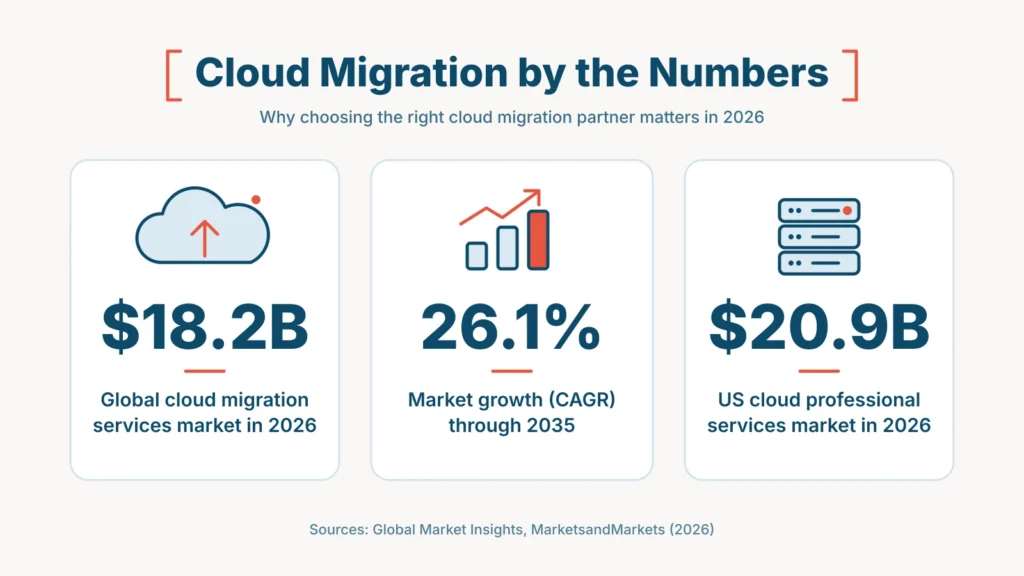
- The global cloud migration services market is expected to grow from $18.2 billion in 2026 to $146.6 billion by 2035, a 26.1% CAGR, with North America as the largest market (Global Market Insights).
- The US cloud professional services market is valued at about $20.9 billion in 2026 and projected to reach $37 billion by 2031, with cloud migration, security optimization and managed services named as the primary growth drivers (MarketsandMarkets).
- Gartner expects accelerating AI demand to push public cloud services growth to 21.3% in 2026, on the way to a $1.48 trillion market by 2029 (Gartner).
Behind those numbers is a simpler story. Legacy data centers are expensive to run, hard to secure, and almost impossible to scale for AI. At the same time, many companies that moved to the cloud early are now rethinking where they run. A growing number are consolidating from Azure onto AWS to simplify operations, reduce licensing costs, and tap into AWS’s broader service ecosystem.
But more money flowing into the cloud also means more ways for a migration to go wrong. Budgets get blown when workloads are lifted and shifted without optimization. Downtime creeps in when dependencies are not mapped. Compliance gaps appear when security is treated as a final step instead of a design principle.
That is why choosing among cloud migration companies matters as much as choosing the cloud itself. In this guide, we break down ten of the most credible providers serving US businesses in 2026: what each does best, where each falls short, who it fits, and the exact questions to ask before you sign.
How We Evaluated the Best Cloud Migration Service Providers
We did not rank providers on brand recognition or headcount alone. A 50,000-person consultancy is not automatically the right partner for a 200-person SaaS company, and an AWS-only boutique will not help a business that needs multi-cloud governance.
Instead, we assessed each provider on six criteria that consistently separate successful migrations from stalled ones:
| Criteria | What we looked for | Why it matters |
| Hyperscaler partnerships | Verified AWS, Microsoft Azure and Google Cloud partner status and competencies | Partner tiers unlock funding programs, credits and direct escalation paths |
| Migration methodology | A documented framework (assess, plan, migrate, optimize) built on the 7 Rs | Prevents ad-hoc moves that create downtime and rework |
| Security & compliance | HIPAA, SOC 2, PCI DSS, FedRAMP and state privacy law experience | US regulators and customers expect compliance from day one |
| Industry experience | Proven work in healthcare, finance, retail, manufacturing and SaaS | Industry context shortens discovery and reduces risk |
| Post-migration support | Managed services, FinOps and continuous optimization | Most cloud savings appear after go-live, not during the move |
| Engagement flexibility | Fit for different budgets, timelines and team models | Your partner should scale with your roadmap, not force a fixed package |
We also weighed value for money. Many US businesses overpay for brand names, then discover that the actual migration work is subcontracted or handled by junior teams. Transparent pricing and senior engineering involvement counted in a provider’s favor.
Top Cloud Migration Companies at a Glance (2026 Comparison)
| Company | HQ | Best for | Cloud expertise | Ideal client size | Relative cost |
| Wishtree Technologies | Lewes, Delaware | Azure-to-AWS and on-prem-to-AWS migrations, AI-ready modernization | AWS (primary), Azure, GCP | Startups, mid-market, enterprise | Moderate |
| Accenture | Dublin, Ireland (large US presence) | Global, multi-year enterprise transformation | AWS, Azure, GCP | Large enterprise | Premium |
| Deloitte | London, UK (large US presence) | Regulated industries and business-led migration | AWS, Azure, GCP | Large enterprise | Premium |
| IBM Consulting | Armonk, New York | Hybrid cloud and mainframe modernization | Multi-cloud, Red Hat | Large enterprise | Premium |
| Rackspace Technology | San Antonio, Texas | Multi-cloud migration with long-term managed services | AWS, Azure, GCP | Mid-market to enterprise | High |
| Slalom | Seattle, Washington | Business-aligned consulting with local US teams | AWS, Azure, GCP | Mid-market to enterprise | High |
| 2nd Watch | Seattle, Washington | Migration plus managed cloud operations | AWS, Azure | Mid-market to enterprise | High |
| Caylent | Irvine, California | AWS-native and cloud-native builds | AWS | Startups to enterprise | High |
| Mission Cloud | Los Angeles, California | AWS migration and managed services for growing companies | AWS | SMB to mid-market | Moderate |
| ClearScale | San Francisco, California | Complex AWS architecture and app modernization | AWS | Mid-market to enterprise | High |
10 Best Cloud Migration Companies for 2026: Detailed Reviews
1. Wishtree Technologies
Best for: mid-market companies and enterprises moving from Azure or on-premises infrastructure to AWS, without enterprise-consultancy overhead
Headquarters: Lewes, Delaware, with offices in the UK and UAE
Core cloud focus: AWS (primary), with Azure and Google Cloud expertise for hybrid and multi-cloud estates
Wishtree Technologies is a US-registered digital engineering company that helps businesses move, modernize and optimize their workloads in the cloud. Where many providers stop at “getting you there,” Wishtree treats migration as the start of a modernization journey. The goal is a cloud environment that is cheaper to run, easier to secure, and ready for analytics and AI.
A large share of Wishtree’s migration work involves moving workloads from Microsoft Azure to AWS.
Companies make this switch for practical reasons: consolidating on one cloud after an acquisition, lowering licensing and compute costs, gaining access to AWS-native data and AI services, or aligning with partners and customers who already run on AWS.
Wishtree’s teams handle the hard parts of that move, from mapping Azure services to their AWS equivalents to re-engineering identity, networking and data pipelines.
Its intelligent cloud migration services combine AI-assisted discovery with phased migration waves. Dependencies are mapped before anything moves, workloads are grouped by risk and business value, and each wave is tested with rollback plans in place. The result is fewer surprises, less downtime, and earlier proof of value.
Key cloud migration services:
- – Cloud readiness assessment, TCO analysis and migration roadmap
- – Azure-to-AWS and on-premises-to-AWS migration
- – Rehosting, replatforming and refactoring based on the 7 Rs
- – Legacy infrastructure modernization for aging servers, databases and monolithic apps
- – Database and data platform migration, backed by Wishtree’s data engineering practice
- – DevSecOps and CI/CD pipelines built for the new environment
- – Cloud cost optimization and FinOps
- – AWS managed services and predictive cloud management and support after go-live
How a typical Wishtree migration runs:
- Assess: inventory workloads, map dependencies, and estimate TCO on AWS versus the current environment.
- Plan: choose an R strategy per workload, design the AWS landing zone, and set migration waves.
- Migrate: move workloads wave by wave, with parallel runs and rollback plans.
- Optimize: rightsize resources, tune costs, and harden security and compliance.
- Operate: hand over to managed services, or train your in-house team to run the new environment.
Why it stands out:
- – AWS-first expertise with real Azure depth. Teams understand both sides of an Azure-to-AWS move, which reduces translation errors in identity, networking and data services.
- – Migration plus modernization. Wishtree does not just relocate technical debt. It modernizes as it migrates.
- – AI-ready outcomes. Data platforms are rebuilt so they are ready for analytics, machine learning and generative AI on AWS.
- – Security built in. Cybersecurity and AI-driven compliance are part of the design, not a final checklist.
- – Speed and flexibility. Engineers can start within 48 hours, with engagement models that range from full project delivery to staff augmentation.
Pros:
- – Strong value compared with large consultancies
- – Senior engineers involved from assessment to go-live
- – Combines cloud, data and AI engineering under one roof
Considerations:
- – Smaller brand footprint than the global consultancies, so a pilot wave is a good way to validate fit
Ideal for: startups, mid-market companies and enterprises that want a focused, technically strong partner for AWS migration, especially from Azure.
2. Accenture
Best for: global enterprises running large, multi-year cloud transformation programs
Headquarters: Dublin, Ireland, with a large US presence
Core cloud focus: AWS, Microsoft Azure and Google Cloud
Accenture is one of the largest technology consulting firms in the world, and cloud is a central part of its business. It works with all three major hyperscalers and brings industry-specific accelerators for sectors like banking, retail, energy and healthcare.
Accenture’s strength is scale. When a Fortune 500 company needs to migrate thousands of applications across multiple regions, while also changing operating models, retraining staff and redesigning business processes, Accenture can staff that program end to end.
Key cloud migration services:
- – Cloud strategy and business case development
- – Large-scale application and data center migration
- – Industry cloud solutions and pre-built accelerators
- – Organizational change management and training
- – Ongoing cloud operations and managed services
Pros:
- – Enormous delivery capacity across regions and industries
- – Deep relationships with AWS, Microsoft and Google
- – Strong change management alongside technical delivery
Considerations:
- – Premium pricing that often exceeds mid-market budgets
- – Longer engagement cycles and heavier governance
- – Day-to-day delivery may be handled by teams other than those in the sales process
Ideal for: Fortune 500 and global enterprises with complex, multi-year transformation goals.
3. Deloitte
Best for: regulated industries that need migration tied to risk, compliance and business strategy
Headquarters: London, UK, with a large US presence
Core cloud focus: AWS, Microsoft Azure and Google Cloud
Deloitte combines cloud engineering with its long-standing advisory strengths in risk, tax, audit and regulatory compliance. That combination makes it a frequent choice for financial services, healthcare, life sciences and public sector organizations, where every migration decision has a compliance angle.
Deloitte tends to start with the business case: which workloads should move, what value they create in the cloud, and how the move affects risk posture and regulatory reporting. Technical execution then follows that roadmap.
Key cloud migration services:
- – Cloud strategy, governance and operating model design
- – Regulated-workload migration with compliance mapping
- – Cloud security and identity architecture
- – ERP and core system migration
- – Post-migration managed services
Pros:
- – Strong governance, risk and compliance expertise
- – Business-led approach that links cloud to measurable outcomes
- – Credibility with boards and regulators
Considerations:
- – High cost, especially for advisory-heavy phases
- – Can be more process-heavy than smaller, engineering-led partners
Ideal for: large enterprises in banking, insurance, healthcare and government that need compliance confidence above all.
4. IBM Consulting
Best For: hybrid cloud environments and mainframe or legacy modernization
Headquarters: Armonk, New York
Core cloud focus: hybrid and multi-cloud, powered by Red Hat OpenShift
IBM Consulting approaches cloud migration through a hybrid lens. Rather than pushing everything to one public cloud, it helps organizations run workloads across on-premises infrastructure, private cloud and multiple public clouds, with Red Hat OpenShift as a common platform.
IBM’s most distinctive strength is legacy modernization. Many US enterprises still run critical workloads on mainframes and decades-old systems. IBM is one of the few providers with deep expertise in modernizing these environments, whether by refactoring, containerizing or integrating them with cloud-native services.
Key cloud migration services:
- – Hybrid cloud strategy and architecture
- – Mainframe and legacy application modernization
- – Containerization with Red Hat OpenShift
- – Cloud security and compliance for regulated industries
- – Managed hybrid cloud operations
Pros:
- – Unmatched mainframe and legacy expertise
- – Strong hybrid and multi-cloud architecture skills
- – Mature security practice
Considerations:
- – Best value for organizations already invested in IBM or Red Hat ecosystems
- – Less suited to small, AWS-first migrations
Ideal for: large enterprises with mainframes, complex hybrid estates or strict data residency requirements.
5. Rackspace Technology
Best For: multi-cloud migrations followed by long-term managed services
Headquarters: San Antonio, Texas
Core cloud focus: AWS, Microsoft Azure, Google Cloud, plus private and hybrid cloud
Rackspace built its reputation on managed hosting and has evolved into a multi-cloud services company. Its value proposition is simple – migrate your workloads, then let Rackspace run them around the clock.
For companies without large in-house cloud operations teams, that ongoing support can be as valuable as the migration itself. Rackspace covers monitoring, patching, security operations, cost management, and incident response across multiple cloud platforms.
Key cloud migration services:
- – Multi-cloud migration and modernization
- – Private and hybrid cloud deployment
- – 24/7 managed cloud operations
- – Cloud security and compliance services
- – Cost optimization and governance
Pros:
- – Broad multi-cloud and hybrid coverage
- – Mature, round-the-clock managed operations
- – Well-suited to companies that want to outsource cloud operations
Considerations:
- – Strongest value comes from long-term managed contracts, not one-time migrations
- – Can be more standardized than custom engineering partners
Ideal for: mid-market and enterprise companies that want a single partner to migrate and then operate multi-cloud environments.
6. Slalom
Best For: companies that want business-aligned consulting delivered by local US teams
Headquarters: Seattle, Washington
Core cloud focus: AWS, Microsoft Azure and Google Cloud
Slalom operates through local offices across major US cities, so clients often work with consultants based in their own region. That local model makes collaboration easier and appeals to companies that value in-person workshops and close partnership.
Slalom’s cloud work is closely tied to business strategy and data. It frequently pairs migration with analytics modernization, helping clients turn their newly migrated data into dashboards, insights and machine learning use cases.
Key cloud migration services:
- – Cloud strategy and roadmap development
- – Application and data migration
- – Data and analytics modernization
- – Cloud-native application development
- – Change management and enablement
Pros:
- – Local US teams and collaborative culture
- – Strong data and analytics practice
- – Business-outcome focus
Considerations:
- – Consulting-led pricing can be high for purely technical migrations
- – Delivery depth can vary by local market
Ideal for: mid-market and enterprise companies that want a close, consultative partner with a strong data focus.
7. 2nd Watch
Best For: mid-market and enterprise companies that want migration plus managed cloud operations
Headquarters: Seattle, Washington
Core cloud focus: AWS and Microsoft Azure
2nd Watch is a cloud-native consultancy that focuses on migration, data and analytics, and managed cloud services. It has long experience with AWS and Azure and positions itself as a partner for the full cloud lifecycle, from first assessment to ongoing optimization.
Its sweet spot is mid-market and enterprise organizations that want a specialist rather than a generalist consultancy, but still need ongoing operational support after migration.
Key cloud migration services:
- – Cloud migration assessment and planning
- – Application and data migration to AWS and Azure
- – Data and analytics platform modernization
- – Managed cloud services and FinOps
- – Cloud security and governance
Pros:
- – Cloud-native specialization
- – Combined migration and managed operations offering
- – Solid data and analytics capabilities
Considerations:
- – Narrower Google Cloud focus
- – Less suited to very small projects
Ideal for: mid-market and enterprise companies on AWS or Azure that want one partner for migration and day-two operations.
8. Caylent
Best For: AWS-first companies building cloud-native applications
Headquarters: Irvine, California
Core cloud focus: AWS only
Caylent is an AWS-focused consultancy that works across migration, modernization, containers, data and generative AI on AWS. Because it specializes in a single cloud, its engineers tend to have deep, hands-on knowledge of AWS services and best practices.
Caylent is a good fit when the goal is not just to move workloads but to rebuild them as cloud-native systems using containers, serverless architectures and managed AWS services.
Key cloud migration services:
- – AWS migration and modernization
- – Container and Kubernetes platforms on AWS
- – Serverless application development
- – Data platform and generative AI solutions on AWS
- – DevOps and platform engineering
Pros:
- – Deep AWS specialization
- – Strong cloud-native and container expertise
- – Modern engineering culture
Considerations:
- – AWS only, so not a fit for Azure or multi-cloud strategies
- – Premium rates for specialist talent
Ideal for: startups and enterprises committed to AWS that want cloud-native modernization.
9. Mission Cloud
Best For: small and mid-sized businesses migrating to AWS that want ongoing support
Headquarters: Los Angeles, California
Core cloud focus: AWS only
Mission Cloud combines AWS migration with managed services and cost optimization. It packages its services in a way that suits growing companies, because such companies typically do not have large in-house cloud teams.
After migration, Mission Cloud can take over day-to-day AWS operations, including monitoring, security, and FinOps, so internal teams can focus on product work.
Key cloud migration services:
- – AWS migration planning and execution
- – Managed AWS operations
- – Cloud cost optimization and FinOps
- – Data, analytics and generative AI on AWS
- – Security and compliance support
Pros:
- – SMB-friendly packaging
- – Strong managed AWS and FinOps services
- – Clear focus on AWS best practices
Considerations:
- – AWS only
- – Less suited to very large or highly complex enterprise programs
Ideal for: SMBs and mid-market companies moving to AWS that want a managed partner afterward.
10. ClearScale
Best For: complex AWS architectures and application modernization
Headquarters: San Francisco, California
Core cloud focus: AWS only
ClearScale is an AWS-focused partner known for architecture-heavy projects. It works on migrations where the technical design is the hardest part: high-traffic platforms, data-intensive systems and applications that need significant re-architecture.
ClearScale typically leads with detailed architecture planning, then handles migration, modernization and DevOps implementation.
Key cloud migration services:
- – AWS architecture design and review
- – Application migration and modernization
- – DevOps and CI/CD automation
- – Data and analytics on AWS
- – Managed services
Pros:
- – Strong AWS architecture expertise
- – Experience with technically complex projects
- – End-to-end AWS delivery
Considerations:
- – AWS only
- – Best suited to projects with meaningful architectural complexity
Ideal for: mid-market and enterprise companies with complex AWS migration or modernization needs.
AWS Specialists vs. Multi-Cloud Partners: Which Do You Need?
The providers above fall into two broad groups, and choosing the right group narrows your shortlist quickly.
| If you… | Consider |
| Are committed to AWS and want deep, single-cloud expertise | Caylent, Mission Cloud, ClearScale, Wishtree Technologies |
| Are moving from Azure to AWS and need expertise on both sides | Wishtree Technologies, 2nd Watch |
| Need multi-cloud or hybrid governance across several platforms | Rackspace, IBM Consulting, Accenture |
| Need compliance-led transformation in a regulated industry | Deloitte, Accenture, IBM Consulting |
| Want a close, consultative partner with a data focus | Slalom, Wishtree Technologies |
The 7 Rs of Cloud Migration: Strategies Top Providers Use
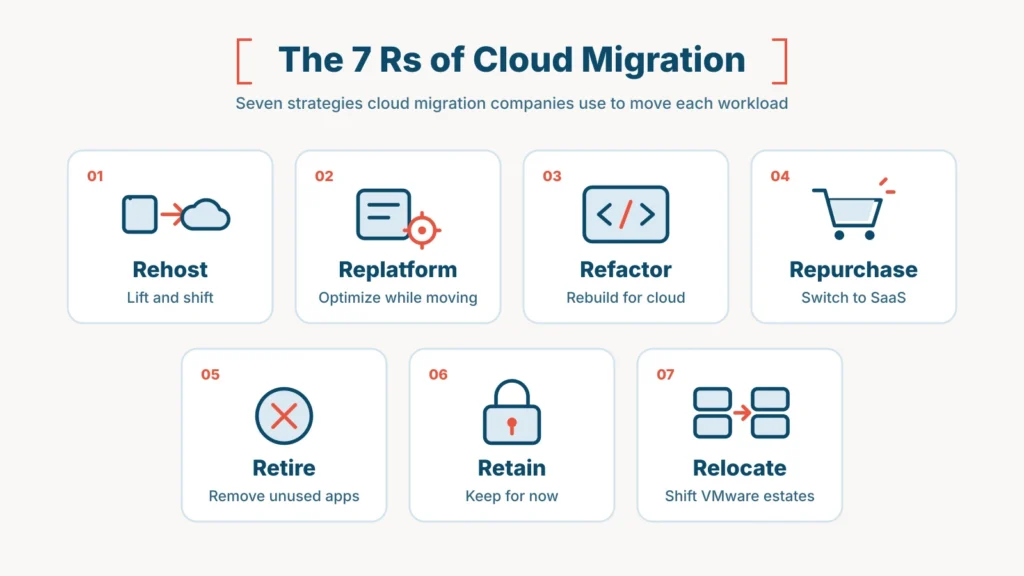
Every credible cloud migration company uses some version of the 7 Rs to decide what happens to each workload. Knowing them helps you judge whether a provider’s plan makes sense, or whether they are defaulting to one approach for everything.
| Strategy | What it means | Best for | Effort |
| Rehost (lift and shift) | Move the workload as-is to the cloud | Fast data center exits, tight deadlines | Low |
| Replatform (lift and reshape) | Make small optimizations during the move, like switching to a managed database | Quick wins in cost and performance | Low to medium |
| Refactor / Re-architect | Rebuild the application to be cloud-native | Scalability, agility and long-term cost savings | High |
| Repurchase | Replace the application with a SaaS product | Outdated off-the-shelf tools | Medium |
| Retire | Decommission applications nobody needs | Reducing cost and complexity | Low |
| Retain | Keep the workload where it is for now | Compliance or dependency constraints | None now |
| Relocate | Move at the hypervisor level, such as VMware to VMware Cloud on AWS | Large VMware estates | Low to medium |
Most real migrations use a mix. A strong partner might rehost 40% of workloads for speed, replatform the databases, refactor two customer-facing apps, and retire a handful of tools nobody uses. A weak partner applies lift-and-shift to everything and leaves you with a bigger cloud bill than your old data center.
Azure to AWS Migration: What US Businesses Should Know
Migration is not only about leaving the data center. In 2026, a growing number of US companies are moving workloads from Microsoft Azure to AWS. The reasons are usually practical:
- – Consolidation: after a merger or acquisition, running two clouds doubles the tooling, skills and governance effort.
- – Cost and licensing: some organizations find better pricing models, savings plans and licensing flexibility on AWS.
- – Service breadth: AWS offers a wide catalog of data, analytics, machine learning and generative AI services.
- – Ecosystem alignment: partners, customers or marketplaces the business depends on often already run on AWS.
An Azure-to-AWS move is not a simple copy. Each Azure service needs a mapped AWS equivalent, and identity, networking and data layers usually need re-engineering.
| Azure service | Typical AWS equivalent |
| Azure Virtual Machines | Amazon EC2 |
| Azure Blob Storage | Amazon S3 |
| Azure SQL Database | Amazon RDS / Amazon Aurora |
| Azure Kubernetes Service (AKS) | Amazon EKS |
| Azure Functions | AWS Lambda |
| Azure Active Directory (Entra ID) | AWS IAM Identity Center (often federated with Entra ID) |
| Azure Data Factory | AWS Glue |
| Azure Monitor | Amazon CloudWatch |
When you evaluate cloud migration companies for an Azure-to-AWS project, look for teams that are fluent in both platforms. A partner that only knows AWS may miss Azure-specific dependencies, while an Azure-heavy partner may not design the AWS landing zone well.
How to Choose the Right Cloud Migration Company: A 7-Point Checklist
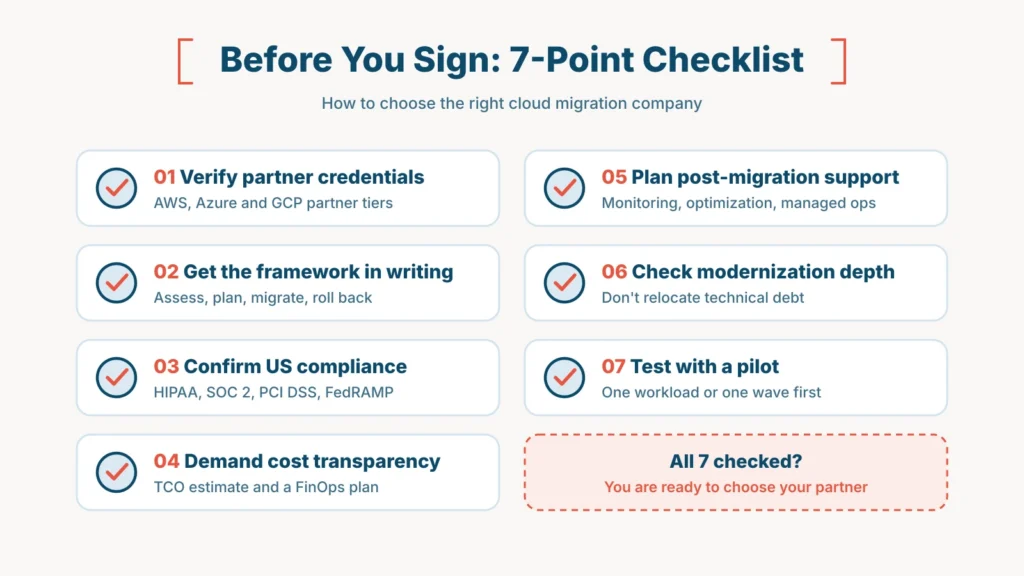
Shortlisting is easy. Choosing well is harder. Use this checklist to compare finalists on what actually predicts a successful migration.
- Verify partner credentials. Look for current AWS, Azure or Google Cloud partner tiers and specific competencies, such as AWS Migration and Modernization. Logos on a website are not proof.
- Ask for the migration framework in writing. A good partner can show you its assessment, wave planning, testing, cutover, and rollback approach before you sign anything.
- Confirm US compliance experience. Ask specifically about HIPAA, SOC 2, PCI DSS, FedRAMP, or state privacy laws, depending on your industry, and request examples.
- Demand cost transparency. Ask how they estimate total cost of ownership and how they prevent post-migration bill shock through rightsizing and FinOps.
- Look beyond the move. Predictive cloud management and support after go-live often matters more than the migration itself.
- Check modernization depth. Moving technical debt into the cloud only relocates the problem. Ask whether they can modernize as they migrate.
- Test the fit with a pilot. Start with one workload or one migration wave before committing to a full program.
Questions to ask every cloud migration provider
- – Who exactly will work on our project, and how senior are they?
- – Which of our workloads would you rehost, replatform or refactor, and why?
- – How will you keep downtime to a minimum during cutover?
- – What happens if a migration wave fails?
- – How will our cloud costs compare with our current spend in the first 12 months?
- – What does support look like after go-live?
- – Can you share a similar migration you completed, ideally in our industry?
Red flags to watch for:
- – A fixed price quoted before any assessment
- – “Lift and shift everything” as the default strategy
- – Vague answers about security, compliance or data residency
- – No clear plan for rollback or testing
- – Senior experts in the sales meeting, but no commitment that they will stay on the project
- – No post-migration optimization or support offering
Common Cloud Migration Challenges (and How the Right Partner Solves Them)
Most failed migrations fail because of planning gaps, hidden dependencies, and weak governance. Here are the challenges we see most often:
| Challenge | Business impact | How a strong partner helps |
| Unexpected downtime | Lost revenue and customer trust | Phased migration waves, parallel runs and tested rollback plans |
| Cost overruns | Cloud bills higher than on-premises costs | FinOps, rightsizing, savings plans and reserved capacity |
| Security and compliance gaps | Data exposure, failed audits, regulatory fines | Security and compliance controls designed in from day one |
| Hidden legacy dependencies | Applications break after the move | Automated discovery and dependency mapping before migration |
| Data migration errors | Corrupted or missing records | Validation, reconciliation and staged data transfers |
| Skills gaps | In-house teams cannot run the new environment | Training, documentation and managed support |
Security deserves special attention. A migration is the best time to fix weak identity controls, unencrypted data, and inconsistent logging. Partners that build cybersecurity and AI-driven compliance into the migration design avoid painful rework later.
How Much Do Cloud Migration Services Cost in the USA?
There is no single price for cloud migration. Cost depends on how many workloads you have, how complex they are, which R strategy you choose, and how much post-migration support you need.
The biggest cost drivers are:
- – Number and complexity of workloads: a few virtual machines cost far less to move than hundreds of interconnected applications.
- – Migration strategy: rehosting is the cheapest upfront; refactoring costs more but usually delivers bigger long-term savings.
- – Data volume and sensitivity: large or regulated datasets need more planning, validation and security work.
- – Compliance requirements: HIPAA, PCI DSS or FedRAMP add design, documentation and audit effort.
- – Post-migration support: managed services and FinOps are ongoing costs, but they protect your savings.
As a rule, ask for a paid or free readiness assessment first. A credible TCO estimate from that assessment is worth more than any headline price.
How Long Does a Cloud Migration Take?
Timelines vary just as widely. As a general guide:
- – Small migrations (a handful of applications, mostly rehosting): a few weeks
- – Mid-sized programs (dozens of applications with some replatforming): a few months
- – Large enterprise programs (hundreds of applications, refactoring, multiple regions): many months to over a year, delivered in waves
The smartest approach is to migrate in waves. Early waves deliver value quickly and build confidence, while later waves benefit from lessons learned.
Cloud Migration Trends Shaping 2026
- – AI-assisted migration: AI tools now speed up discovery, dependency mapping, code analysis, and even refactoring.
- – AI-ready infrastructure: many companies now migrate so they can run AI workloads. As Gartner notes, AI demand is a major driver of cloud growth this year.
- – Cloud consolidation: more organizations are moving from multi-cloud sprawl to one primary cloud, often AWS, to simplify operations.
- – FinOps by default: cost governance is now built into the migration plan rather than added after the first surprise bill.
- – Hybrid and sovereign cloud: regulated US industries want tighter data residency, governance, and control.
- – Security-first design: zero trust, identity-centric security and automated compliance are becoming standard requirements.
Moving workloads is only step one. If your end goal is AI, your data layer needs attention too; see our take on AI implementation challenges.
Why US Businesses Choose Wishtree for AWS Cloud Migration
Large consultancies bring scale, and AWS boutiques bring specialization. Wishtree Technologies sits in the space between: deep AWS engineering, real Azure fluency, and the flexibility of a focused partner.
Here is what US businesses get when they work with Wishtree:
- – AI-assisted assessment that surfaces dependencies, risks, and cost-saving opportunities before anything moves
- – Azure-to-AWS expertise, with service-by-service mapping across compute, storage, identity, networking and data
- – Migration plus modernization, so legacy systems are improved rather than simply relocated
- – Data and AI readiness, with data platforms rebuilt for analytics, machine learning and generative AI on AWS
- – Security, compliance and FinOps built into the design from day one
- – Flexible engagement models, from full project delivery to dedicated engineers who can start within 48 hours
- – Post-migration managed services for monitoring, optimization, and continuous improvement
Whether you are leaving an aging data center, consolidating from Azure, or modernizing a platform that already runs in the cloud, Wishtree’s cloud migration services in USA are built to reduce risk and deliver measurable value quickly.
Conclusion: Choosing the Right Cloud Migration Partner for 2026
The best cloud migration company is not necessarily the biggest name on this list. It is the one that fits your workloads, your target cloud, your compliance needs, and your budget.
If you are a global enterprise running a multi-year transformation, Accenture, Deloitte, or IBM Consulting can provide the scale you need. If you want a long-term managed partner across several clouds, Rackspace and 2nd Watch are strong options. If you are all-in on AWS and want deep single-cloud specialists, Caylent, Mission Cloud and ClearScale are worth a look.
And if you want AWS migration expertise, especially from Azure, combined with modernization, data and AI readiness, and the speed of a focused partner, Wishtree Technologies is built for exactly that.
Whichever provider you choose, follow three rules. Start with a clear assessment, migrate in waves, and plan for optimization from day one. That approach turns cloud migration from a risky IT project into a lasting business advantage.

Frequently Asked Questions (FAQs)
What do cloud migration companies do?
Cloud migration companies help businesses move applications, data, and infrastructure from on-premises systems or another cloud to platforms like AWS, Azure, or Google Cloud. Their services usually include readiness assessment, migration planning, execution, security, testing, and post-migration optimization and support.
How do I choose the best cloud migration company for my business?
Start with your target cloud and workload complexity. Then compare providers on partner credentials, migration methodology, compliance experience, cost transparency, modernization capability, and post-migration support. Running a pilot migration wave is the most reliable way to test the fit.
How much do cloud migration services cost in the USA?
Costs depend on the number and complexity of workloads, the migration strategy, data volume, compliance needs, and ongoing support. A detailed readiness assessment with a total cost of ownership estimate is the best way to get a realistic figure.
How long does a cloud migration take?
Small migrations can take a few weeks, mid-sized programs a few months, and large enterprise programs many months or more. Migrating in waves delivers value earlier and reduces risk.
Why are companies migrating from Azure to AWS?
Common reasons include consolidating onto one cloud after mergers, improving cost and licensing flexibility, accessing AWS’s broad data and AI services, and aligning with partners or customers that already run on AWS.
What are the 7 Rs of cloud migration?
The 7 Rs are rehost, replatform, refactor, repurchase, retire, retain, and relocate. Each is a different approach to moving a workload, and most migrations use a mix of them.
Is cloud migration secure?
Yes, when it is planned well. A strong partner builds encryption, identity and access management, compliance controls, and monitoring into the migration from the start, rather than adding them afterward.
Should I choose an AWS-only partner or a multi-cloud partner?
If you are committed to AWS, an AWS-focused partner offers deeper expertise. If you are moving from Azure to AWS, choose a partner fluent in both. If you will run several clouds long term, a multi-cloud partner with strong governance is a better fit.