
TL;DR
- – Most AI pilots fail in production because of fragmented data, weak access control, accuracy demands, and runaway compute costs.
- – Model choice is no longer the moat. Your data control plane is.
- – Governance belongs at the data layer, not in prompt-level patches.
- – Judge AI on retrieval accuracy, auditability, concurrency, cost-aware routing, and task completion, not on demo quality.
Introduction
I am going to call it early. The honeymoon era of AI experimentation is over.
Over the last two years, almost every executive team set aside budget for generative AI pilots.
Thousands of slide decks were presented, internal chatbots were spun up in afternoons, and impressive proofs-of-concept were celebrated in boardrooms.
Yet, as we move through late 2026, an uncomfortable pattern has emerged across the enterprise landscape.
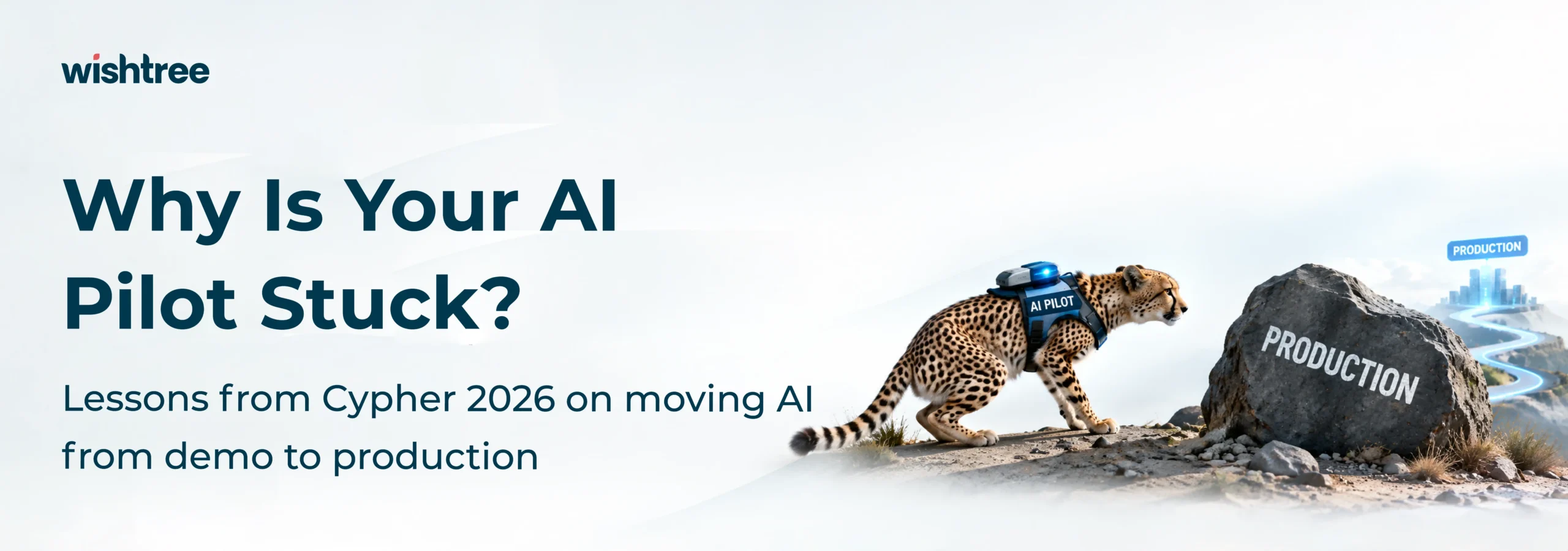
The projects we are brought in to rescue all look the same. Most never leave the sandbox.
And the few that reach production bleed cash on unoptimized compute or get halted by legal and security.
Getting an AI demo to work in a test environment is easy. Building a secure, reliable, cost-predictable AI system that runs across core enterprise workflows is a different discipline entirely.
If your leadership team is tired of funding endless pilots and wants to see actual operational return from your software investments, reach out to our engineering leads at Wishtree.
The demo trap vs. production reality
Why do so many promising AI prototypes break the moment real employees start using them?
In a quick demo, you control every variable. A few clean, static documents, a carefully written system prompt, and predictable test inputs.
Production software enjoys none of those luxuries. When AI meets real enterprise operations, it faces four hard engineering realities.
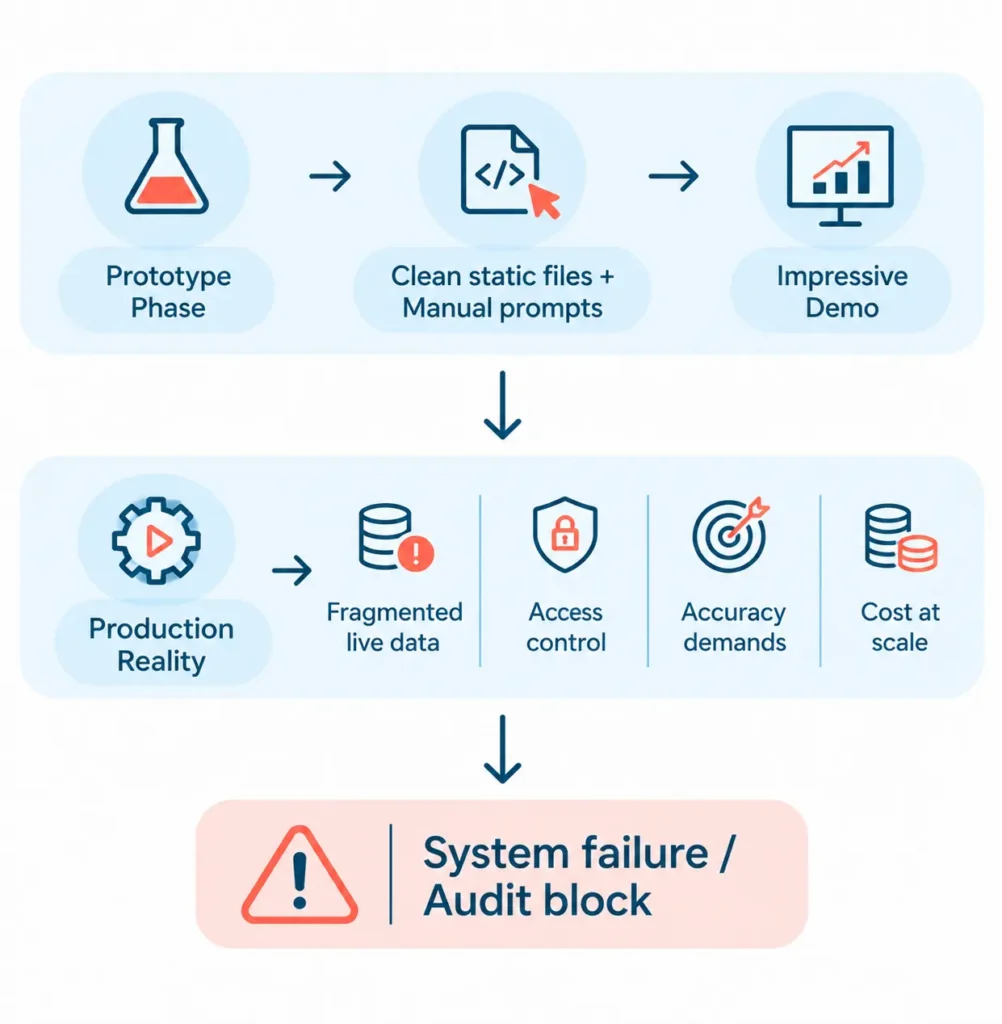
- Fragmented live data. Business context sits across legacy databases, ERP tables, operational logs, and third-party APIs.
- Access control. A junior support rep and a financial director should not see the same data in an AI response.
- Accuracy demands. A 90% accuracy rate may look fine in a vendor deck. In payroll, supply-chain routing, or clinical documentation, a 10% error rate can be a dealbreaker.
- Cost at scale. Route every employee request to a top-tier LLM without governance, and software costs can escalate quickly.
For high-stakes workflows, design for the errors you cannot eliminate – confidence thresholds, human-review queues, and clear escalation paths.
From model selection to data control planes
Everyone used to think winning at AI meant licensing the “smartest” model. Not anymore.
Foundation models are converging in capability, and the gap between top providers shrinks every quarter. Model choice still matters, but it is no longer the moat.
The real advantage – and the key to production stability – is your data control plane.
Mature teams do not patch security rules and prompt guardrails onto front-end code. They enforce governance at the data layer.
Build a unified lakehouse architecture with Databricks Unity Catalog – and you get one control plane for all enterprise data.
Permissions, audit trails, and privacy masking are managed at the root. When an AI app queries your systems on behalf of a specific user, it inherits that user’s permissions, so the support rep and the finance director each see only what they are allowed to.
That removes the most common source of leakage, AI retrieving data the user should never see.
Pair it with input and output guardrails, and you have defense in depth rather than prompt-level patches.

Measuring what matters: The five production metrics
Forget how impressive the demo looked. If you want AI to deliver real business outcomes, hold it to operational engineering metrics instead.
Before a line of code is written, decision-makers are asking:
- – Is the system retrieving the exact, fresh business records needed to answer the query accurately?
- – Can you audit every piece of data the AI accessed to generate a specific output?
- – Can the system handle peak concurrent requests across your operations without grinding to a halt?
- – Are you routing routine queries to smaller, fine-tuned models while reserving high-cost models strictly for complex reasoning?
- – Is the tool actually finishing the multi-step administrative task, or is a human still doing 80% of the manual work?
When you shift your internal evaluation criteria to these five metrics, your engineering team stops tweaking prompts and starts building resilient software.
How we help teams cross the finish line
Turning a fragile prototype into enterprise-ready software takes real depth across cloud infrastructure, data pipelines, and product engineering.
Skip the strategy decks. You need a partner who writes production code that holds up under load.
At Wishtree, we work alongside CTOs and engineering directors to clean up fragmented data stacks, build strict data governance guardrails, and ship scalable software built on cloud platforms like AWS and Databricks.
Scale your engineering capacity fast
If your internal roadmap is falling behind or you need specialized data engineering skills to fix a broken pipeline, scale your team with Wishtree developers within 48 hours to accelerate your rollout.
Validate architecture before long-term commitments
Do not sign a massive contract just to find out if an architectural fix actually works for your workload. To test our engineering team on a real-world project first, start a risk-free trial with Wishtree today.
Frequently Asked Questions (FAQs)
Why do AI projects get stuck in the pilot phase for months?
Most pilots fail to make the jump because they were built as isolated experiments, not integrated software. Another reason can be that there is no evaluation framework to prove they are production-ready.
The moment you connect the AI tool to live enterprise databases and enforce real security policies, the data stack breaks under the complexity.
How do we keep our AI compute costs under control as usage scales?
Cost control comes down to intelligent query routing. Do not send every request to an expensive frontier model. Route simple tasks like data retrieval and categorization to smaller, cheaper models. Save the frontier models for complex reasoning.
Pair routing with response caching, prompt caching, and token budgets per workflow. Together, these routinely cut inference spend significantly without hurting quality.
Do we need to replace our current cloud setup to make our data AI-ready?
No. Modern lakehouse platforms and unified governance layers sit directly on top of your existing cloud infrastructure (such as AWS S3 or Azure Blob Storage). You can implement strict data controls and real-time pipelines without tearing down your current hosting setup.
How can Wishtree help us move a stalled AI pilot into production?
We step in as a hands-on execution partner. We audit your existing data layer, eliminate security bottlenecks, optimize pipeline performance, and write the production code needed to integrate AI tools directly into your day-to-day software stack. Contact our team today to get started.